Saturday, January 16, 2016

OPPOSITION GIVES ULTIMATUM TO SBC; PROTEST MARCH

A crowd of protesters marched to the Seychelles Broadcasting Corporation (SBC) in Hermitage from Victoria yesterday to deliver a message to the hierarchy of the national television station: they expect the SBC to do better and stick to its mandate of neutrality.


The opposition movement under the banner Union for Change has called for a reform of the Seychelles Broadcasting Corporation’s (SBC) editorial policies to meet the its Constitutional mandate. The opposition leaders have also given the national broadcaster two weeks to organise a meeting with them to listen to their grievances, saying that failure to do so will result in another protest march against the SBC.

 Four of the six Presidential candidates who took part in the first round of the Presidential election - Wavel Ramkalawan, Patrick Pillay, Alexia Amesbury and Philippe Boullé – yesterday delivered a letter to SBC’s chief executive officer (CEO), Antoine Onezime, and to the chairman of the SBC board, Patrick Nanty, in which they expressed their strong objections to what they say is “SBC’s continued and augmented bias in favour of the Parti Lepep government in its coverage of national affairs, to the exclusion of other opinions, in particular of the voice of the opposition”.


The letter, which was read out to supporters who had taken part in the march that started at the Stad Popiler, before being handed over to its recipients, stated that since the election, the SBC has maintained a continued barrage of publicity in favour of Parti Lepep “with the appearance of one or more Ministers every night on television, speaking about projects that were part of the political programmes of the opposition parties in the recent election campaign”.

It further adds that “a sense of independence and objectivity could only have been conveyed by including the views of the opposition in the reporting, which the SBC continuously failed to do”. The letter deplored and condemned the fact that the SBC continues to ignore the views of half the population.

The opposition leaders also condemned the SBC’s actions before the election and during the campaign period which they said “showed the same bias and favouritism and in some instances went as far as to repeat the propaganda of the Parti Lepep, thinly disguised as ‘news’”. The leaders wrote that such actions by the SBC were wrong and unfair and that it was an abuse of a state institution in favour of one candidate.


“The editorial bias of the SBC is contrary to its Constitutional mandate to be independent and is a disservice to the democratization process in Seychelles”, the letter continued as it called on the chairperson of the SBC board, Patrick Nanty, to ensure that editorial reforms are carried out as soon as possible to meet its Constitutional mandate. It also called on the SBC to implement recommendations set out in the Reilly Report of 2007 which addresses the need for independence of the state-funded broadcaster.

Speaking before the march, the leaders said that the opposition fight will continue until there is “real freedom” in Seychelles. Patrick Pillay, the leader of Lalyans Seselwa, said, “we will not remain quiet until we attained real freedom and democracy”. For his part Philippe Boullé, praised what he said was a good job done by the majority of SBC staff but added that they were unable to do their job properly because of political interference. Alexia Amesbury focused her short speech on a call for women voices to be heard and said that Thursday’s march was not only a call for the opposition but for all women who are today unable to express their views.

Safe behind the locked gates; SBC staff look on
Mr Ramkalawan also addressed the crowd, calling on them to march in peace and to refrain from any act of violence. His call for peace and order was respected by all supporters, who after two hours of protest dispersed peacefully. The organisers say there were about 800 to 1 000 protesters who marched.

Source: Today in Seychelles

SBC REFUSES TO FILM HEARING; ELECTION PETITION

The hearing is set to open on 15 February and close on 3 March unless more time is needed.

The court challenge of the results of the 2015 Presidential election was mentioned in court on Thursday 14th January and hearing will start on Monday 15 February, the Chief Justice announced.

This information was also conveyed to stakeholders in a meeting between the lawyers of the Union for Change movement, those of the respondents in the case and Chief Justice Mathilda Twomey on Wednesday.

Antoine Onezime; CEO of SBC
 The hearing will go on for two weeks straight, following which “an assessment will be carried out to evaluate the progress and decisions will be taken,” the Seychelles National Party (SNP) leader, Wavel Ramkalawan explained in a post of social media. This will happen on 3 March.

The respondents - James Michel, Hendrick Gappy, the Chairperson of the Electoral Commission and the Attorney General, Ronny Govinden, have be given 14 days to file their defense. The court will reconvene on 9 February and more time will be granted if such is needed until the hearing begins on 15 February.

 Because of the high public interest of the case, the Union for Change movement had requested that the court case be filmed by the Seychelles Broadcasting Corporation (SBC) and that it is also projected outside the courtroom on a big screen for opposition supporters who would not be able to gain admittance to the courtroom which can only accommodate 48 persons.

But Mr Ramkalawan said that “the SBC have said that they do not have the resources”, to film the hearing. Three lawyers have also been assigned the responsibility of producing a daily summary of the day’s proceedings which will be made available to the public.

The petitioner, Mr Ramkawalan is represented by a team of lawyers led by Bernard Georges, while Basil Hoareau is representing James Michel, Samantha Aglae is representing the Electoral Commission and the Attorney General’s office is represented by David Esparon. Some 80 witnesses are expected to be heard during the court of the trial.

The two petitions were filed after the Presidential runoff which took place between 16 and 18 December.

The first petition lodged on December 28 requests that the Constitutional court declares null and void the results of the second round and the subsequent “election” of James Michel as it alleges that the Electoral Commission wrongly calculated the results. The petition wants the Constitutional court to interpret clearly what the Constitution says regarding the calculation of the percentage of votes.


The second, an Election petition filed on January 5, claimed that the Presidential runoff did not comply with certain provisions of the Elections Act and that the election was not free and fair because numerous illegal practices were committed by the ruling party, Parti Lepep.

Source:Today in Seychelles

Saturday, January 9, 2016

IT’S ON!; OPPOSITION TO DEMONSTRATE AGAINST SBC

Wavel Ramkalawan accuses national television station of being guilty of political propaganda in support of Parti Lepep.

The opposition under the banner “Union For Change “ yesterday informed the Commissioner of police Ernest Quatre that it will be organising a protest march on Thursday 14 January at 3pm against the Seychelles Broadcasting Corporation (SBC). The demonstration which will start in town and end in front of the SBC, aims to protest against what the Seychelles National Party (SNP) leader has said is SBC’s “ongoing campaigning for Parti Lepep”, in particular through the programme “News Extra” with Finance Minister, Jean Paul Adam.

The SNP’s last march in December 2014.
Complaints against the SBC have reached a peak these past weeks especially leading to the 2015 Presidential election. The national broadcaster was criticized for its poor performance in the early hours of December 6, when it failed to keep the viewers informed about the election results and instead played countless repeats of comedies. Since the announcement of the second round, opposition supporters have accused the station of “political propaganda” as it gave Ministers generous airtime to talk about pertinent national issues aimed at giving the Parti Lepep government political mileage.

This week, the Minister for Finance, Trade and Blue Economy, Jean Paul Adam has featured in at least three News Extra programmes, in which he gave detailed explanations about his 2016 budgetary address, which was presented on December 23. Among his topics were the 13th month salary scheme which comes into effect this month as well as the setting up of an anti-corruption body to address the issue of corruption in the country.

Mr Adam’s appearance on national television again on Thursday evening prompted the leader of the SNP, Wavel Ramkalawan to post a comment on popular Facebook group, Seychelles Daily, asking:“For how long more are we going to tolerate the SBC campaigning for Parti Lepep through the programme ‘News Extra’ with Jean-Paul Adam every evening?”, suggesting that “we should show our dissatisfaction with SBC by organising  a demonstration”.


This comment posted late in the evening on Thursday was quickly picked up by followers on social media who supported the call for a protest march. This prompted Mr Ramkalawan to suggest that if the comment reached a thousand likes by 9am on Friday 8 January, then he will write to the Commissioner of police, notifying him of the event.

The opposition supporters got busy, with some staying up till early morning to monitor the progress of the “Likes”, which reached its target of one thousand after 1am.


Subsequently, Mr Ramkalawan posted a copy of the letter sent to the police on Friday morning, notifying him of the protest march and the routes that will be taken - from the Victoria Stadium car park to SBC headquarters at Hermitage.

SBC protest 1992
Meanwhile, Minister Jean-Paul Adam, whose appearance on national TV had prompted the call for a protest, also took to social media on Friday to question the opposition’s accusations. He asked whether the SNP wouldn’t have used the national media to present its budget if elected, arguing that it was every government’s right to explain its plan to the public. “Instead of organising a demonstration, why doesn’t SNP present the alternative budget it was proposing to the population?”, he asked, further adding that “maybe the reality is that there was no budgetary plan behind all the promises that were made prior to the elections”.

The protest march will be the first by the opposition this year following Mr Ramkalawan’s recent call for the supporters “to make their voices heard”.


The last demonstration was in December 2014 when hundreds of SNP supporters took to the streets of Victoria for a peaceful march against the high cost of living, following the 2015 budget speech.

Source:Today in Seychelles

Friday, January 8, 2016

PREVIOUS 11 YEARS AND NO PARDON; MICHEL ABUSED HIS POWERS FOR A VOTE

Omerta on Flossel François’ liberation

The opposition says the man, a convicted murderer, was pardoned in exchange for his companion’s political allegiance. And although the man was released on the first day of polling of the second round, government has denied any wrongdoing.

Roland Felicie (centre) who has cancer, was released on bail on compassionate grounds in July last year following several failed requests for Presidential pardon.
Government confirmed on Wednesday that Flossel François, a man sentenced to life imprisonment some 15 years ago, was released following a Presidential pardon. No details were given about the circumstances of the pardon, barring a press release issued by the ministry of Social Affairs stating that, “since the matter has apparently been made a live issues in a pending court case, government says it will refrain from commenting any further on the matter”.

The reason the communiqué was released was to deny “any wrongdoing in the pardoning of any convicts”.

The Social Affairs ministry also explained that “pursuant to Article 60 of the Constitution of Seychelles, clemency is considered and granted only upon receiving the recommendation of the Advisory Committee on the Power of Pardon” and maintained that “all the formalities laid down by the law were complied with, to pardon the individual concerned”.

The details of those formalities weren’t disclosed however and this newspaper has been unable to obtain any information on the procedures. Contacted, the office of the Registrar of the Supreme Court explained that the courts aren’t involved in pardons. The prison authorities have been equally silent.

Sources tell this newspaper however that the Advisory Committee which is chaired by the Principal Secretary (PS) of the ministry of Social Affairs, Linda William Melanie, recommended the pardon of Mr Francois on 15 December and that the pardon was granted the very next day, on 16 December, which was also the first day of the second round of the 2015 Presidential election.

Questions pertaining to the grounds on which Mr Francois was released, the justification for the release on polling day as well as details of the pardon itself were sent to the Social Affairs ministry, but remained unanswered at the time of going to press. The information, this newspaper has been told, will be made available at a later date.

The illegal President of the Seychelles
While the issue of Presidential pardon itself is not being contested, it is the circumstances of the pardon that have raised suspicions. The matter first came to light earlier this week when the Seychelles National Party (SNP) claimed in its second petition contesting the election that a supporter of Lalyans Seselwa, Dania Valentin from Roche Caiman, was induced to give her support to the ruling party following “a promise (...) that her companion Flossel Francois who was serving a life sentence, would be released from prison if she spoke on the PPB of Parti Lepep, having already spoken in favour of Patrick Pillay in a previous PPB on 1 December 2015”.

Reliable sources tell this newspaper that Mr Francois was indeed released on 16 December following a recommendation by the Advisory Committee the day before. This development is deemed suspicious by opposition parties since no known pardons have been granted to convicts in the past.

Human rights lawyer Alexia Amesbury, for one, has regularly deplored the fact that the Presidential pardon has never been granted. Contacted for a comment, she said: “I have repeatedly stated publicly that one of the qualities of a good leader is that of compassion. I have also stated publicly that for the 11 years that Mr. Michel has been President, that despite having the power to pardon, he has not used it once. He refused to pardon a prisoner who had contracted cancer whilst at the Marie Louise prison. The poor man died in custody.

“In the last couple of years, we have watched programmes of restorative justice from Montagne Posée prison, where we saw the case of Jane Labiche, a female prisoner who is serving a life sentence; the mother of the child who died has forgiven Jane publicly on television. A human rights barrister from New Zealand visited Seychelles and met me to discuss the Jane Labiche case as I was her lawyer and he too enquired into the possibility of getting Ms. Labiche pardoned. The President refused.

“And now, for the sake of getting a vote, the President pardons a convicted murderer. This is not only a shame, it is an outright abuse of power and I will go so far as to say, it is a violation of Article 60 which gives him the power to pardon, because a power when given should be exercised in accordance with law and for a proper purpose. It should not be abused as the President has done in this instance. There are many more deserving cases”.


Alexia Amesburys` 5th PPB during the Presidential election featuring Roland Felicie

In July last year, Mrs Amesbury managed to obtain freedom for another convict Roland Felicie who is suffering from colon cancer. Though he was also denied a pardon, he was eventually released on bail in July last year on compassionate grounds after Mrs Amesbury filed a bail application.

Speaking to TODAY in an interview that will be published next week, the SNP leader Wavel Ramkalawan also questioned the decision: “What we find strange is the fact that Mr Michel is in no habit of releasing people, not even those who are sick and I can recount a personal experience. At our parish at St Luke, we had Maxwell Duval, a man who had been convicted of a drug offence. He suffered from cancer, got married on his death bed and the congregation signed a petition on Christmas Day a couple of years back and that petition was sent to Mr Michel to ask that Mr Duval be released to spend his final days at home. He did not even reply”.

SOURCE: Today in Seychelles


SBC DOES NOT FULFILL ITS CONSTITUTIONAL OBLIGATION

Letter to the editor.
09 January 2014
TODAY NEWSAPAPER

Dear editor,

In your front page article entitled “’Be fair and balanced media commission tells SBC”, in your issue of 09 January 2014, you quote from the report of the Media Commission deliberating on a complaint by the SNP party of SBC’s coverage of their conference as follows: “If the SBC wants to live up to the norms of impartiality as provided in Article 168(2) of the Constitution..”


As a member of the constitutional commission which deliberated publicly for many months to draft the Constitution that was ultimately approved in a referendum on 18th June 1993, allow me to quote exactly what the Constitution says in regard to a broadcasting media which the government owns or controls or provides with a contribution from the public funds, which SBC currently is:

ARTICLE 168.(1) The State shall ensure that all broadcasting media which it owns or controls or which receive a contribution from the public fund are so constituted and managed that they may operate independently of the State and of the political or other influence of other bodies, persons or political parties. (2) For the purposes of clause (1), the broadcasting media referred to in that clause shall, subject to this Constitution and any other law, afford opportunities and facilities for the presentation of divergent views.

Nowhere does the Constitution speak about impartiality. Impartiality is expected of any news media in a democratic society when it makes an editorial judgement, whether funded by the government or not. The Constitution, however, wanted to ensure that a broadcasting media funded by the State is constituted and managed so that it operates independently of the State (government), political parties or other influences and afford opportunities and facilities for the presentation of divergent views.

In his REPORT OF THE INQUIRY INTO THE EVENTS IN VICTORIA ON 3 OCTOBER, 2006, after the police assaulted a group of peaceful demonstrators on the precinct of the National Assembly causing grievous bodily harm to some, Judge Michael Riley, who was appointed to chair the inquiry by President James Michel, remarked that it is a reasonable perception that the Board of SBC is composed in the main of Government supporters or employees of the Government and rejected the argument put forward by the government that civil servants are the only people with the knowledge to make the board function. For this reason, Judge Riley said, as such it cannot be said that SBC was truly independent of the State. He recommended an alternative method of making appointments to the board of SBC, which involves inputs from the general the public as well as the National Assembly voting in favour of the people being appointed, who should not be civil servants. Despite his public commitment to accept without reservation the report and to implement its recommendations, President Michel has not been true to his words.

The Puppet; James Michels` Press Secretary 
Judge Riley also noted that despite the fact that Article 170 (Schedule 7) of the Constitution further imposed an obligation on the State (government) as follows: “The State (government) shall, within 12 months of coming into force of this Constitution bring the Seychelles Broadcasting Corporation Act 1992 into conformity with article 168”, the government in the hands of the SPPF/Parti Lepep did nothing to bring the SBC Act 1992 into conformity with the Constitution. It was not until 2012 when I filed a case in the Constitutional Court asking the court to dismiss the existing board and appoint another board to run the broadcaster until the a new Act was passed, that a new SBC Act was passed. Sadly the new Act was new only in terms of the date it was passed and makes no provision for implementing the recommendations of Judge Riley or the constitution in respect of the independence of the board.


Until SBC becomes a public broadcaster (like the BBC) rather than just an outlet for the government and the ruling party to make one sided official propaganda rather than information, we will not have fairness nor impartiality in the news or information it disseminates. I have sent a draft new SBC Act, based on the principle of public broadcasting that has this purpose in mind to Mr Afif of the Media Commission with the view of getting the Media Commission to hold public debate on its merits. That was years ago.


 Paul Chow

HOW SOCIAL MEDIA HAS CHANGED SEYCHELLES

Public expression of opinions did not start with social media but its presence has had a lasting impact on the way Seychellois communicate.

Seychelles' first woman Presidential candidate Alexia Amesbury has gone on the record to say that one of the reasons the 2015 Presidential election panned out the way it did, was because to social media. Whether this statement is true or not, it is beyond doubt that part of the electoral campaign took place on social media. And reflecting the fact that the country is divided into two parts - the reds and the greens - there are two main political groups involving Seychellois on Facebook: Dan Lari Bazar, a pro Parti Lepep group which has about 28 000 members and the opposition group, Seychelles Daily, which has some 24 000 members.


Two other groups, Gossip Corner (about 21 000 members) and The Truth Nothing But The Truth (about 11 000 members) are less political but nonetheless get a good amount of traffic. Many people are members of all four groups. For Mrs Amesbury, the freedom of expression that people have found on social media, has helped liberate those who feared that expressing their opinions might get them in trouble. Issues that were formerly only spoken about in the privacy of one's home are now discussed openly and this, in turn, has encouraged others to be freer with their words.

A Seychelles Daily participant and rights activist, Wavel Woodcock, told TODAY that “it feels like people are more expressive nowadays whereas before there was a certain fear of intimidation or even losing one’s job but now people are no longer afraid. I think that people now know they have rights and that they are free to express themselves. When something is wrong or fishy, a large majority will now come out and say it – for example, if there's an unacceptable comment made in the State media, people will come forward and express themselves and make noise about it. I feel that social media has created a movement and has given a voice to the voiceless where State media failed them by not allowing them to have a say before".

An administrator of the group The Truth Nothing But The Truth agreed: “Facebook has allowed for more freedom and it has become one of the few places where people, especially the younger generations, can express themselves freely. Before you would see many fake profiles but more and more, you'll see people using their own profiles to do so whereas before they would not dare do so. Facebook has become one of the ways that people use to pass on information and a place where they feel safe.”

As a result, it’s not surprising that it’s on social media where Seychellois who have access to the internet, whether they live here or abroad, followed the counting of the ballot papers. Again in this instance, social media filled in where the State media failed. While there was a complete blackout on the proceedings by the Seychelles Broadcasting Corporation (SBC) during the first round while the country was awaiting the results with bated breath, Facebook filled in.

Likewise, faced with the Electoral Commission's refusal to make public provisional results, several agents of political parties chose to update the provisional results, district by district, on their pages. The pages also became the place where people who probably do not know each other, comforted and reassured one another as the suspense mounted. But all is certainly not rosy. In fact, most of the time, an inordinate amount of insults and character assassinations take place on social media in all impunity.

Interestingly, lawyer Bernard George is of the opinion that “Facebook has not changed anything when it comes to how people express themselves. It has only made their comments more widely available. Before the only option was to write a letter in the newspaper for example but with Facebook people’s views can now reach a wider audience”.

On the subject of cyber bullying, the lawyer says that “people can say what they want but cannot bully or defame someone. These are the only exceptions to freedom of expression. Therefore, if somebody does that, they will have to pay damages – that is straightforward. It is a case of tort which in Seychelles is called ‘delict’ which basically means that any action of somebody which causes damage to another person obliges the person who has caused the damage to repair it”.

But in life as on social media, this does not seem to be a recourse favoured by Seychellois. An active blogger of pro Parti Lepep group, Dan Lari Bazar, said for his part that he does not believe social media has made much of a difference in terms of freedom of expression. Speaking on condition of anonymity, he said that issues are not tackled on social media. "What I see instead is people tagging along and not necessarily expressing their views. Nothing constructive is achieved on Facebook. Instead, people are repeating what everyone else is saying without asking questions or testing the credibility of the source. For example, pre-election, you’d see people popping up to say that they were offered such and such from whomever, without realising that somebody could be fishing for information from you. Instead the reaction was also that of a herd mentality. If someone came from the opposition and said something, people would automatically bash them and try to destroy their credibility, say things about their family and this is wrong – regardless of who does it".


Whatever one's opinion on the matter, the fact is that there is less scope for opacity with social media. The discovery of the Bel Ombre skull is a good example of this: it was discovered by workers who took a photo of the skull and posted it on social media. Discussions started almost immediately, suppositions as to the identity of the skull were put forward, family members of the presumed person were contacted, making it eventually impossible for the police to refuse to open an enquiry, even if the results are yet to be disclose.

SOURCE:Today in Seychelles

Wednesday, January 6, 2016

A COUNTRY’S DESTINY ON TRIAL

The debate at every street corner of our beloved island is centred around the petitions for declaring the last Presidential election void. The legal team will be filing 2 separate petitions structured in all the necessary legal technicalities. Every man and his dog about town have their respective opinions as to whether the trial will be fair and free from quiet interference from the ruling party. Whether judges will act as judges ought to or will history be repeated and once again deal a stacked hand against the majority of this forsaken country.

Filing of First Petition
Although formal election campaigning has now ceased, the pointer measuring election fever remains deep in the red scale. But as we patiently await the dates for the court hearing, the ruling party is doing their utmost to create a veil of normality over our day to day activities. And I look forward to the expected spin that our Minister will have to come up with when the subject of the famous “Renaissance Sociale” is once again packaged as the solution to all our social ills. How is our Minister going to tackle this small matter? How is he now going to act the saint and preach the gospel of “Renaissance Sociale” values? No doubt he will require to brush his acting skills up! We all await with earnest anticipation.

This trial is more than simply a matter for the courts to deliberate and conclude. Our country’s destiny is at stake. It will be a crucial stepping stone in how we will measure the values and beliefs that our future generation will have at hand in shaping our future. What template will the young leaders of this country for them to emulate? Unfortunately our recent history since the coup of 1977 leaves much to be desired in terms of example for emulation.

As far as past political heads of state are concerned, our country has yet to find its version of Nelson Mandela or have a meagre portion of the qualities of the great Gandhi. Fortunately the formation of Linyon Sanzman may be a timely platform in providing an avenue for good men and women to take on the clear and present evil that overwhelms this country. We have today the makings of what this country deserves to take us from this very dark past. It is not simply a question of gaining power but a duty for all to cease this opportunity and redirect our destiny. This country cannot survive on self praise, on self appraisal, and a constant overdose of spin, lies and deceit. And voluntary respect of the Constitution is where it all begins.

Filing of Second Petition
This country will start breathing once we start culturing the notion of self development as a priority, as opposed to seeking the immediate option of the begging bowl. And certainly not as one politician calls it, “the need for Seychelles to have a godfather figure”. No sir, this is not where this country will discover pride, self esteem and individual well being. This is why we are where we are today. It’s the poor vision of our past leaders willing to be lured towards the glitter of diamonds whilst sacrificing the necessity to first culture its people. We need to be economical in all our endeavours, cut waste. And finally we need not simply do things right, but we need to start doing the right things. As a proud nation. As a hard working society. As an honest and cultured people.

This country is desperate for a clean start. A clean moral slate. We will watch the judges as they deliberate. We need no favours, but we are also judges. This is the right of every citizen. And we will judge. We will judge if the verdict is a verdict for Seychelles. If there was ever a moment in our history that a “Refreshed Seychelles” is due, it is now.

God bless Seychelles.


Roy Fonseka

CONVICTED MURDERER RELEASED IN EXCHANGE FOR SUPPORT TO PARTI LEPEP?

2015 PRESIDENTIAL ELECTION

The second petition filed by the SNP yesterday contains an alarming number of allegations of irregularities, supported by affidavits, that are said to have taken place during the second round of the election and that unduly influenced the outcome of the process. The SNP also claims that over a thousand letters were distributed to people by the Social Welfare Agency, offering them supplementary income in exchange for their votes.


The Presidential candidate of the Seychelles National Party (SNP), Wavel Ramkalawan has filed a second petition in the Constitutional court yesterday, in which he averred that the 2015 Presidential election should be declared null and void as it did not comply with certain provisions of the Elections Act and because numerous illegal practices were committed by the ruling party, Parti Lepep, thus preventing free and fair elections.

 In this second petition, Mr Ramkalawan avers that the irregularities were so numerous that they cast serious doubts on the fairness of the election process. In those circumstances and in light of the fact that only 193 votes separate Wavel Ramkalawan and James Michel, he has asked that the 2015 Presidential election be declared null and void.

The election petition also states that there were irregularities in the counting of ballot papers and that this affected the results of the election. It thus seeks a recount of the ballot papers used nationwide in the election.

The election petition is the second petition to be filed by the leader of the SNP who contested the Presidential runoff under the banner “Union for Change”, with the support of three other opposition candidates. The election petition has been filed under Article 51 of the Constitution and Section 44 of the Elections Act, CAP 68A.

The first petition filed on Monday 28 December averred that the announcement of the percentage awarded to contender James Michel was incorrect and therefore the Certificate of election issued to Mr Michel “was erroneous, improper and illegal”. It averred that no candidate won more than 50% of the votes cast and asked the court to declare the election null and void and to order a third ballot or subsequent ones until such time one candidate received more than 50% of the votes cast.

 As was the case for the first petition, the second one is also being served against three respondents which are the Electoral Commission represented by its Chairman Hendrick Gappy, James Michel, the leader of Parti lepep and the Attorney General, Ronny Govinden.

 Mr Ramkalawan presented over 20 affidavits to support his claims that the Presidential runoff was marred by illegal practices. These included affidavits from people who were approached and offered large sums of money to vote for the ruling party or who were made offers that sought to write off their loans as well as those who were promised loans.

More specifically, the petition claims that over a thousand letters from the Social Welfare Agency offering supplementary incomes to voters in order to induce them to vote for Parti Lepep, were also issued in the days leading to the Presidential runoff. Long queues were said to have been observed at the agency’s office at Oceangate House.

The petition also claims that opposition supporters who were former government officials and thus close to the ruling party, were approached and offered high positions in government if they agreed to back Parti Lepep. The petition alleges that the leader of Lalyans Seselwa, Patrick Pillay was approached by former President Albert Rene and offered a high post in government if he gave his support to Parti Lepep. Another supporter of Lalyans Seselwa, Vincent Remie Larue, was offered “a good post in the government” if he agreed to change political allegiance while Peter Rodney Jules also from Layans Seselwa was allegedly contacted by Sylvette Pool and offered “anything he wanted, including the writing off his loans with the Small Business Finance Agency, if he procured the vote of former supporters of Parti Lepep who had switched to the opposition”.

The petition also claims that a former Lalyans Seselwa supporter from Roche Caimain, Dania Valentin, who spoke in the Party Political Broadcast (PPB) of Lalyans Seselwa prior to the first round and who subsequently endorsed Parti Lepep in a PPB during the second round, was told her companion who was sentenced to life imprisonment and who had served 15 years already, would be freed if she switched allegiance. According to the petition, her companion was indeed released on the first day of polling of the second round, on December 16. This was a couple of days after she agreed to feature in James Michel’s PPB.

Dania Valentin
The election petition further claims that the authorities used scaremongering tactics to threaten the electorate into voting for the ruling party, including threats that UAE-based airline, Etihad Airways, the minority shareholder of the national airline Air Seychelles, will pull out of its commitment in Seychelles in the eventuality of a victory of the opposition and that this would lead to loss of jobs and economic hardship for Seychelles.

The case of the Speaker of the National Assembly, Patrick Herminie who sought to engage into party politics during the cooling off period was also mentioned. He told viewers of the Seychelles Broadcasting Corporation (SBC) that hardships would ensue if Mr Ramkalawan were to be elected President, as he would not get the support of a Parti Lepep-led National Assembly. He said the National Assembly would block any budget presented to the National Assembly by an SNP-led government, therefore leading to “shutdown”.

The petition also states that scaremongering also targeted civil servants, as they were told they would lose their jobs if they did not keep Parti Lepep in power. The name of Beryl Botsoie, the head teacher of La Rosiere School was cited. This woman, in a school meeting in the days leading to the second ballot, accused SNP leader of arrogance and invited voters not to vote for him “and warned them that if the petitioner (Ed’s note: Mr Ramkalawan) was elected, they risked their livelihoods in general and in particular they won’t be paid as the new government would be unlikely to pass a budget”.

A similar incident was also recorded at a meeting of the Seychelles People’s Defense Forces (SPSD) officers on December 11 2015 where top military personnel including Lt Colonel Clifford Roseline, Reverend Louis Agathine, the SPDF’s chaplain and Major Simon Dine, Coast Guard Commander, accused Mr Ramkalawan “of arrogance, selfishness and being disorderly, or making empty promises and clearly inviting the members of the SPDF not to vote for him”.

The election petition adds that National Drug Enforcement Agency (NDEA) officers also abused their position on December 18, which was main polling day, where they were seen in areas knows to be drug hotspots, to intimidate drug users and prevent them from going to the polls.

Businessman, James Lesperance’s name is also cited in the petition which avers that he paid money to Adolphe Jason Dubel, Ron Philippe Laporte and Steve Elie Labrosse and 12 other young men, “in return for their identity cards so as to prevent them from voting during the second ballot”.

With regards to irregularities in the counting of ballot papers, the petition claims that votes cast in special voting stations did not tally with seven polling stations in electoral areas, showing a discrepancy “amounting to nine votes, two fewer and seven extra”.

These electoral areas were Anse Boileau, Au Cap, Anse Etoile, Bel Air, English River, Glacis and Pointe Larue. For instance, 259 residents of English River had voted at the special polling stations ahead of the main polling day and yet, three extra enveloped were added to the ballot boxes, bringing the total number to 262!

There were also discrepancies in three other polling stations where the number of votes counted did not tally with the number of ballots issued; these were Anse aux Pins Cascade and Glacis. Mr Ramkalawan said the Electoral Commission “has not been able to satisfactorily explain” these discrepancies. The petition also claims that in Anse aux Pins, two ballot papers were marked by ballpoint ink instead of the black marker supplied to voters.

The Election petition also cites a number of cases of non-compliance to the Elections Act by the Electoral Commission. It states the commission failed to ensure that the ink and invisible spray used were of good quality. Furthermore it failed to ensure that each voter could only cast one vote as it allowed a special voting station at the National Library on the main polling day on December 18th and could not satisfactorily verify whether people had voted more than once.

Mr Ramkalawan also states that at least “two unknown persons voted in the special polling station in the names of Damion Charles Hoareau and Stan Nerick Fanchette, both voters registered in the Inner islands electoral area”.

 It said that the Electoral Commission also failed to prevent the “withholding of Identity cards by staff of the North East Point Home for the Elderly and coaching of elderly voters by the Acting nursing sister at the Home”.

The election petition will be served on the three respondents this week, and the case is expected to be heard as soon as the Constitutional Court resumes its session next Monday.

The result of the presidential runoff was declared on December 19, giving SNP, 49.85% of the total votes cast and 50.15% to Parti Lepep, something the opposition is saying is factually incorrect. There were 63,893 votes cast in the second round, with 62,831 valid votes and 1062 votes rejected.

Source: Today in Seychelles


Tuesday, January 5, 2016

THE BIG INTERVIEW WITH BISHOP JAMES WONG

By DB

"I wouldn't be surprised if we go into a third round"

Anglican Bishop James Wong was perhaps one of the most vocal dignitaries in the country in the weeks leading to the 2015 Presidential election as well as during its aftermath. For this reason and because of the fact that he is politically neutral, we chose him as our first guest for this year. In the interview that follows, Bishop Wong does not paint a very pretty picture of what he witnessed during what was probably one of the most important democratic events in Seychelles' post independence history.


2015 was a bit hectic for Seychelles and we ended the year with a warning which you made during a post electoral meeting with the election observer missions to the effect that there might be violence in the country following the results of the election. That did not happen but do you think the warning is still valid as we start this year?

My comments came following persistent rumours as well as reliable information that I had to the effect that the risk of violence following the proclamation of the results was high. There was an unfortunate incident in Port Glaud and I learnt that somebody had been shot with a rubber bullet there. There was also the Cascade incident. So yes, there were some tense incidents but fortunately, they were not as widespread as we had feared. The tension in the country was so palpable and I could not very well say to international observers, "well done, we'll happily wait for your report in three months". I took issue with the fact that the observers refused to say whether the election was free and fair, a statement either way would have calmed things and reassured many. It can't be that hard - either it was free and fair or it wasn't. The Church does not support any political party but we hear many things and we work with the information that we receive. And I have no qualms saying it - the observers' stance - their refusal to say whether the election was free and fair - was not acceptable. If SADC could have presented a preliminary report after less than a week, what stopped them from releasing the final one?

But they explained why they deferred the publication of their findings. What do you say to their argument that they don't want to prejudice the court case that will be heard soon?

That argument does not convince me since some of those observer missions have still not released their final reports following the elections in 2011!

Then what is point of their presence in the country to observe the election? Do you feel that their presence is important to the election process?

I think it is important to have them here as long as we hear their conclusions and they release their reports based on their findings. It is important to have this assessment from the international community but it does not need to take as long as it has for them to release their reports.

But what difference does their presence make? The fact that they were here did not stop many things that should not have happened from happening. Bishop Wiehe, the Seychelles Interfaith Council (SIFCO) and yourself issued important messages to the voters and the political parties but were they heeded in the end?

I think the answer is yes, it has made a difference in the sense that it reassures people in terms of the confidence in the democratic process. On both rounds of the election, Bishop Wiehe and myself went around all the polling stations and during the first round, it was a joy to have been able to encourage and give strength to people who spent a lot of time waiting in the queues. It was a joy to encourage many youngsters to have patience, it was a joy to give a smile to people as they were queuing up, as a way of saying, “you did well, you have gone to vote”. And I think that the number of people that came down to cast their votes has been very encouraging and, in this sense, the voice of the church and of SIFCO has been heard. During the second round, I was able to address the nation through the SBC, to encourage voters to go to the polling stations early, to vote so the process of counting could start as soon as possible. And I think this was done in most polling stations.

What about the other messages, were they heard? Especially the one about not selling one’s vote?

The message was do not sell and do not buy. If there's no one buying, there'll be no one selling. And it was a very funny situation that we witnessed on the eve of the first round. People were queuing up at Oceangate House to buy new ID cards.

What do you mean by "buying" cards?

Well one has to pay for new ID cards. And to be able to obtain a new ID card, one has to go to the police station and declare the current one lost. So I asked myself how come so many people had suddenly lost their ID cards on the eve of election. Why this sudden urgency to get new ID cards?

You'll be even more surprised to know that the procedure was free for two weeks prior to the election but that this was never advertised through normal channels! And this brings us back to free and fair elections: the observers have not released their report but you were there and you saw how things went so what is your conclusion?

What we saw on the polling days, Bishop Wiehe and myself, has been very encouraging. We saw people coming down to vote en masse and this was our main objective. What happened inside the polling stations was not part of our observation because we weren't allowed to go in even though some very nice Presiding officers did kindly let us in at some polling stations. From what we saw, everything did seem to be going well inside the polling stations. Those who had difficulties were helped and I think that the staff of the Electoral Commission did a very good job.

But to me, what surprises me - and I don't know what the law says, I am only talking about the sense of right and wrong - if there's any contestation of the election result, a swearing in ceremony should not have taken place. I think it would have been better to wait for the clearance from the Electoral Commission, the Constitutional Court to say what has happened exactly and to say who the winner actually is. But I suppose that the fact that the chairperson of the Electoral Commission had already declared that the winner was James Michel made it "normal" for James Michel to be sworn in.

Except that the argument still hasn't been settled with regards to whether James Michel actually got more than half the votes cast or not. But by the time this mistake was realised, Mr Michel had been sworn in by the Chief Justice and Mr Gappy had stopped "commenting"! And despite this confusion, Ministers have been sworn in and Parti Lepep is ruling the country and there's been no institution that has come out and said, "wait a minute, are we making a mistake?" What do you make of this?

This is precisely the reason I raised the concern with the electoral observers. Had they come out and said the election was free and fair, then fine, no problem. But the fact that they have not been able to say the election was free and fair is the problem. The chair of the African Union said that there had been incidents in one polling station but added that she couldn’t generalise. But if there were incidents in one polling station and that this incident could bring any candidate 1000 votes...

... Or even just 200!

Or 200 - it could have swung the election! She cannot say that incidents in one polling station should not be generalised when it could actually change the results of the election. Her correct report should have been that there had been incidents in one polling station that could have had a bearing on the election results! That was my main concern when I spoke to the SADC observers. And what will they actually say in their final reports, is what I'd like to know. They all said they had heard reports of buying and selling of ID cards but that they can’t prove it. They can't prove it and yet they all mention it?

That said, Seychelles still being a young democracy, I think that we are still in the process of learning. We've seen what happened in the first round and the last voter at Anse Etoile voted at 11pm and we have learnt from those mistakes and the second round was much better. I think we have to see it as a process of learning. Seychelles is still in the process of learning and this is why it is good for us to go through those unfortunate occurrences so that we can learn from them. I think that Seychellois in general have shown a lot of maturity but that, at the same time, some have shown that they can be bought and this is so sad. The Seychellois need to realise that people have fought so that today they are given this power to vote and for the sake of our ancestors who fought so hard to get the right to vote, we have to learn not to sell our dignity.

Maybe this can be explained by the past? What is a vote worth if it can be nullified by a coup d'état?

Again this is where the process of learning comes in. Whatever has happened in the past, happened in the past. We need to learn from the past. It is important for the Seychellois nation to grow and understand the value of their vote.

And 2016 will be very important in that respect. A petition was filed last week and we have the National Assembly elections to look forward to. Democratically speaking, this will be a big test for the country, don't you think?

Again, I think the political parties - and I'm talking about both sides - will be working very hard at the grassroots level and this is good for our democracy. And I think both sides will have to go and get engaged in electoral education. The Church will also have to play the role of electoral educator. The Electoral Commission (EC) has to put the emphasis on electoral education. The whole of Seychelles has to go through a time of training to understand what the role of an election is.

It didn't seem to me that the party in power was too much in favour of voter education during the last election…

At SIFCO, very early on, even before the election was announced, we were already thinking about the education of voters and all our communiqués went towards this. And again, both sides of the political spectrum have to learn from mistakes made in the past. And because democracy is still young here, we have to take time to learn from past mistakes and grow. Both Parti Lepep and the opposition parties will need to put the emphasis on the training, whatever the means. As for the Church, we can do it through Sunday worship. A lot has to be done.

Do you think the Electoral Commission also needs to learn from its mistakes?

At the time, we decided to start our voter education campaign, we felt at SIFCO that we needed to involve the EC but the issue was that the EC was not seen by the Seychellois as independent. In many circumstances, we have seen that the Seychellois do not have enough trust in the Electoral Commission and this was obvious in the way the opposition parties' request for a softcopy of the voters register was dealt with. But as time went by, I think Seychellois and then the political parties started to trust the EC a little bit more. Even on the day the results were proclaimed, Wavel Ramkalawan thanked the EC so there has been a shift in the perception, at least by political parties.

A few days before the election, we did a joint SIFCO-EC service for the first time. Teaching the people, getting people to understand the value of their vote, this is what voter education is about. The members of the EC should take the initiative for the next elections. And might I add, you are talking about the National Assembly elections but I wouldn't be surprised if there was a third round soon!

Do you not feel that the hierarchy of the EC has shown that they are not fully independent from the establishment?

I would not say that unless I have proof. That said, the concern I had was when Judge Renaud ordered the EC to give the opposition parties the softcopy of the voters register and they did not. That wasn't good.

And you still feel that if we go to a third round, the EC as it is, could be trusted to do its job independently?

I think the fact that Wavel Ramkalwan thanked them was a sign of the trust he had in them.

You are one of the very few people in Seychelles who represents an institution and speaks his mind. And you've said some things in the course of this interview that will not go down very well with a few people. Would it be fair to say that contrarily to others, you're not afraid of repercussions?

To be honest, I am here in Seychelles to work for the Church and to work for God. I have demonstrated my political neutrality throughout my stay in Seychelles and I am so happy that my clergy agreed that we need to be neutral in all our actions and we have demonstrated our neutrality. From what I understand however, for some politicians, being neutral means to be against them. But we are not against any political party; we are not in favour of any political party. And this is where the strength of the Church lies - in our neutrality. We will never side with anyone. But we have a duty to tell the truth.


The President knows about my neutrality, so does the Vice President. Wavel Ramkalawan also knows I am neutral, as does Patrick Pillay. In 2016, we will maintain this neutrality, we will maintain our mission to educate voters. I must say though that I have heard that even though we are committed to neutrality, some parishioners have said that Bishop is doing politics. I have heard that. If educating people means that I am doing politics then I am doing politics. But partisan politics, never! And I was so happy that the message of the Church and the message of SIFCO was well-received. I was on La Digue last week and people came up to me to ask whether I was Bishop Wong and they said "thank you for your message". The message was and remains to learn to be good voters and encouraging all parties to do what's right.

Source: Today in Seychelles

Wednesday, December 30, 2015

2015 PRESIDENTIAL ELECTION; RAMKALAWAN ASKS COURT TO ORDER A THIRD BALLOT

A first petition contesting the election results was filed yesterday with Wavel Ramkalawan asking the Constitutional Court to declare null and void the result of the Presidential runoff and the subsequent "election" of James Michel. The Seychelles National Party (SNP) alleges that the Electoral Commission wrongly calculated the results and that there was no winner in the second round.

The Presidential candidate of the Seychelles National Party (SNP), Wavel Ramkalawan yesterday filed a first petition under Article 130 of the Constitution, contesting the results of the Presidential runoff held on 16, 17 and 18 December.


The petition filed by lawyer Bernard Georges yesterday morning, averred that the Chairman of the Electoral Commission, Hendrick Gappy was wrong to award a certificate of election to James Michel, declaring him the winner of the 2015 Presidential election, since no candidate won more than 50% of the votes in the runoff.

 The SNP is therefore asking the Court to order the Electoral Commission to hold "further ballot/s until such time as a single candidate receives more than 50% of the votes in the election".

This argument is based on the premise that the announcement of the percentage of votes allocated to contender James Michel was incorrect; therefore the certificate of election issued to Mr Michel “was erroneous, improper and illegal”.

The petition explains that based on the calculation of votes cast, Mr Michel received 49.319% and not 50.15% as stated by the Chairperson of the Electoral Commission, Hendrick Gappy when he proclaimed the results.

The petition says that the total votes cast were 63,893 and that the total votes cast in favour (valid votes) were 62,831 while 1062 votes were rejected. James Michel won 31,512 votes while Wavel Ramkalawan was said to have won 31,319 votes.

"The Chairman of the Electoral Commission immediately thereafter publicly announced that the petitioner had received 49.85% of the votes and the second respondent (James Michele) has scored 50.15% of the total votes cast", paragraph 14 of the petition averred.

Following this, the petition says, Mr Gappy "acting purportedly under paragraph 9 of Schedule 3 of the Constitution, presented the second respondent with a certificate of election, declaring that the second respondent was duly elected to the office of President".

But Mr Ramkalawan avers that "the said announcement was incorrect and the certificate was erroneous, improper and illegal"

 Speaking to TODAY, Mr Ramkalawan’s lawyer, Bernard Georges said that "we want the Constitutional Court to interpret clearly what the Constitution says regarding the calculation of percentage of votes in the runoff of the Presidential election”.

The issue is that the Constitution makes mention of "votes" and the Elections Act makes mention of "votes cast" and is explained further in the petition.

"Based on a calculation of the votes cast - whether rejected or not - and the figures compiled by the first respondent (the Electoral Commission) itself, (...) the second respondent (James Michel) has in fact only received 49.319% of the votes cast in the second ballot".

Mr Georges told TODAY that "we are alleging that if the percentage had been calculated correctly, none of the two candidates would have received the amount necessary to be elected President, in this case 50% plus one, therefore the elections should be declared null and void”.

The petition is asking the Court to declare that the Constitution has been contravened, to declare that James Michel has only received 49.319% of the votes, to declare null and void the certificate of election issued to James Michel by Hendrick Gappy and to order the Electoral Commission to hold further ballots until a candidate obtains more than 50% of the votes cast.

The petition which will be heard by the Constitutional Court has to be served on three respondents, namely the Chairperson of the Electoral Commission, James Michel and the Attorney General.
Lawyer Bernard Georges explained the choice of respondents by saying that it was “Mr Gappy who made the mistake in the calculation”. James Michel is also a respondent as "he stands to be affected by the ruling”.

Mr Georges said he expects the court to serve the petition on the three parties today at the latest. “Naturally I do not expect them to accept the petition and they will surely prepare their defense to counter our claim”.

The timing of the case is at this point uncertain as Mr Georges explains that under the law, the respondents would need to be given time to prepare their defense. He said that it will only be then that a date will be fixed for the hearing and a panel of judges chosen to hear the petition.

“We have been informed by the Court that the case will be given due consideration and we expect it to be given priority although we cannot confirm at this point when the hearing will start”, said Mr Georges.

To note that all courts are presently in recess and will resume during the second week of January.

Mr Georges also confirmed that a second petition will be filed next week requesting that the results of the Presidential runoff be declared null and void, based on irregularities recorded on polling day. “The Election petition will have two components; firstly it will outline all the irregularities which took place and secondly it will call for a recount of the votes”, he said.

Mr Georges added that the legal team was still gathering evidence for the second petition and will be ready to file it on Monday 4 January.

Both petitions will be heard by the Constitutional Court.

Meanwhile, Wavel Ramkalawan has called on all opposition supporters to “remain calm and let justice take its course”.

Mr Ramkalawan said that the Union for Change movement will be keeping supporters updated and called on them to be ready for the hearing once the case starts “as it is not just us leaders who should be participating and following the case, but all the 31,319 persons who voted for the opposition in the runoff”.


The result of the Presidential runoff was declared in the early hours of December 19, giving SNP, 49.85% of the total votes cast and 50.15% to Parti Lepep. Mr Gappy has so far refused to comment on the allegations of error in the calculation of votes.

Source:Today in Seychelles

Tuesday, December 29, 2015

SEYCHELLES PRESIDENTIAL ELECTION DEBACLE; MAURITIAN LAWYER DEPORTED

The deportation is believed to be politically-motivated as the lawyer is friendly with colleagues working on the petition to contest the Presidential election.

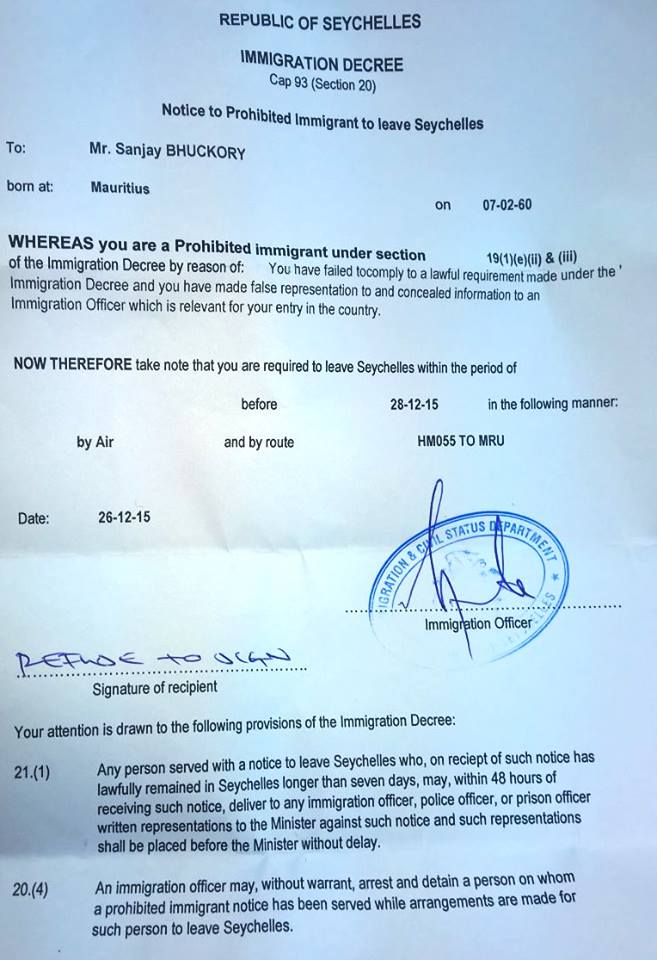
A well-known Mauritian lawyer, Sanjay Bhuckory, was refused entry into Seychelles on Saturday night and deported back to Mauritius yesterday morning. This is believed to be a politically-motivated act as Mr Bhuckory, who is better known for having led Mauritius' only legal case that rendered null and void the election of a Member of the National Assembly on the basis of electoral bribery, was also here to visit lawyer friends involved in the opposition's petitions to contest the Presidential election.


Immigration authorities have confirmed the deportation of the lawyer to TODAY but have refused to say why they have refused entry to Mr Bhuckory and his two children who were made to sleep on a bench at the airport.

In an immigration decree handed to him and which the lawyer refused to sign, the reasons given for refusing entry to a citizen of neighbouring island Mauritius which is also a member of the Indian Ocean Commission (IOC) were that "you have failed to comply to a lawful requirement under the Immigration Decree and you have made false representation and concealed information to an Immigration officer which is relevant for your entry in the country".


A travel agent who had arranged for Mr Bhuckory and his family's trip said she was told by the immigration officer that "the order to deport him came from above".

The travel agent said she contacted Home Affairs Minister Charles Bastienne and asked him not to involve politics in this but that "he never replied to me".

The Immigration Department said they will officially comment today, adding that Mr Bhuckory had "misled Immigration officers at the airport".

Friends of Mr Bhuckory insist that the lawyer, who was planning to spend a few days in Seychelles with his children, has nothing to hide. "Their hotel was booked, they were on a private visit. There was no reason not to allow them in".

Sources say however that people in government had caught wind of the lawyer's visit and that the decision to stop him from entering the country was already made "because they want to hinder the preparation of our petition".

"Except that a person does not need a GOP to come on holiday and that people are supposed to be free to discuss and exchange ideas with one another", the travel agent said.

Rendering an election null and void

In 2008, the Privy Council, which is the highest court of Appeal for Mauritius, upheld a Supreme Court judgment that rendered null and void the election of Ashock Jugnauth to Mauritius' National Assembly. It was a first in the country's history. Electoral bribery is rather common but it was the first time that the matter was taken to court. The plaintiff was a defeated candidate of the Labour party, Raj Ringadoo, who was represented by Sanjay Bhuckory and they sought to prove that Mr Jugnauth’s (who is the half brother of Mauritius' current Prime Minister) election was a result of benefits he gave to people in his constituency in his capacity as a Minister and were in fact acts of electoral bribery. Mr Bhuckory won the case in the Supreme Court and again before the law lords of the Privy Council and Mr Jugnauth's election was duly annulled.

Source:Today in Seychelles

Monday, December 28, 2015

BEL OMBRE SKULL; NOW WHAT?

Now that the election is over, will there be an update on the results of the DNA tests done on the skull in Mauritius?

Reliable sources have told this newspaper that the police now know the identity of the person the skull belonged to and are getting ready to send an officer to Mauritius to collect the results.
 This has not been confirmed by the Commissioner of police who nonetheless told TODAY that the "enquiry is ongoing".


This enquiry has been controversial since the very beginning. Previously the police had announced that the results had been inconclusive but that they were still awaiting the results of further tests on the samples sent to Mauritius six months ago.


The skull was officially disinterred on 16 May following claims on social media that workers of the then construction site of the H hotel in Bel Ombre had found and then reinterred a human skull, lower jaw and bullet casings.

Source:Today in Seychelles

Wednesday, December 23, 2015

THE LEGAL BATTLE BEGINS; 2015 PRESIDENTIAL ELECTION

The SNP says that it will leave no stone unturned as it contests the result of the election with the support of the other members of the Union for Change.

Two days after the results of the Presidential election were proclaimed, the opposition is maintaining its stance that the process was not free and fair and will therefore contest the outcome in the Constitutional Court. The party scored 31 319 votes compared to the 31 512 for Parti Lepep, a difference of 193 votes. During a press conference on Monday, the SNP’s Presidential candidate, Wavel Ramkalawan, vouched that the opposition will leave no stone unturned in its pursuit of the truth. “We owe it to our supporters. We are not making a fuss for nothing, we want the truth”, he said. Mr Ramkalawan promised that the opposition will explore all legal avenues, both locally and internationally, to resolve the matter.


He said that the opposition does not accept the results as the election was marred by “a dirty campaign where state resources were abused and ID cards were bought to prevent voters from exercising their right and the ruling party used scaremongering tactics to influence voters into voting for them”.

He maintained that the election did not take place in “normal” circumstances: “If Mr Michel had won the election fair and square then we would not be meeting today and we would have accepted the results. This election was ours and we are not going to give in without a fight”. In fact, the SNP, in concert with the other political parties which backed it during the second round under the banner of the Union for Change, on Monday filed a petition requesting a recount of all votes cast during the runoff.

A letter to that effect was presented to the chairperson of the Electoral Commission, Hendrick Gappy, right after the results were announced. Mr Ramkalawan said a recount was needed as there were “confirmed” irregularities in three districts, “meaning voting did not go well”. He cited the example of Anse aux Pins where two extra votes were unaccounted for and at least two votes were marked with a pen instead of a marker as required by law.

He also mentioned two other incidents of irregularities in Cascade where one vote was unaccounted for and in Glacis where the station was short by one vote compared to the number of people who had voted. Mr Ramkalawan said the opposition is positive that if there is a recount more discrepancies will be uncovered. He added that if a recount proves the results proclaimed did not tally then “we hope there will be a third round or fresh elections”.

The second petition, Mr Ramkalawan said, concerns the Constitution and he questioned whether “Mr Michel won 50% plus one vote as stipulated by Schedule 3 of the Constitution”. He cautioned that people should not draw parallels with the 2011 PDM case when the party led by David Pierre won a seat in parliament after contesting the results based on valid votes cast. “The Constitution and the law make different provisions for Presidential and parliamentary elections and we should not let ourselves be confused by this”, explained Mr Ramkalawan.

He also announced that the opposition will submit an election petition which, according to the Constitution, can be filed within ten days of the election, and 14 days according to the Elections Act. “In this petition we will outline all the illegal practices that took place prior and during polling day”, he said, adding the document will contain evidence of vote buying and other illegal practices which were brought to their attention.

In the event that the petition is accepted by the court, the election will be declared null and void making way for a third round or fresh elections. Mr Ramkalawan said the election petition will seek fresh elections so that Seychellois people can “express themselves freely in a clean campaign without the illegal practices that were observed in the second round”. When asked why the party is filing so many cases, Mr Ramkalawan said the opposition is making use of all the legal options to show how serious it is about the issue.

On the issue of whether the swearing in should have taken place on Sunday Mr Ramkalawan said that although the opposition does not accept the outcome, they recognize that the Constitution states that the winner must be sworn in within 48 hours after the results have been proclaimed. Mr Ramkalawan used an example of an athlete to explain what can take place if the results are declared null and void. “When an athlete is accused of doping, his or her results are maintained until evidence is finalized and then the athlete is stripped of his or her medal. So this is the state we find ourselves in today”.

As to how long the case might last, the former presidential candidate and leader of Seychelles Party for Social Justice and Democracy, Alexia Amesbury, explained that such cases are usually fast tracked and dealt with in a swift manner. The press conference at Arpent Vert was attended by the other former Presidential candidates who backed the SNP in the runoff, namely Patrick Pillay, Alexia Amesbury, and Philippe Boullé. Also in attendance were the SNP’s Vice Presidential candidate, Roger Mancienne, Roy Fonseka and Ahmed Afif from SPSD and Lalyans Seselwa respectively, as well as representatives of the British High Commission and the American Embassy.

Source:Today in Seychelles