Monday, June 15, 2015

ANSE CACHEE BEING RAPED; ENVIRONMENTAL DISASTER IN SEYCHELLES

One of the worse man made environmental disasters is taking place at Anse Cachee in the district of Takamaka with the approval of government; police officers are even provided to guard and protect the disaster.

The raping of Anse Cachee
A group of foreigners have established base at Anse Cachee and have made use of heavy machinery to inflict irreparable damage to the environment and the disgust of the residents. Heavy machinery was used to remove the vegetation from the beach front; something that is punishable by law. Furthermore, they have destroyed the corals which gave the beach its unique identity and piled up boulders onto the beach. It is atrocious. The turtles that nest there are now being obstructed by a huge container.


What is even more disturbing if that the activity is taking place right under the nose of one of the most ardent supporter of the environment, the well-known Miss Lena Desaubin. It may well be that the foreigners are using part of her property for their activities. If that is the case, she will be guilty of colluding with them in destroying our environment. Though the beach in question is secluded, the residents of Takamaka are extremely upset. Though access to beaches is a right to every Seychellois, access to this particular beach is being denied by a very elaborate security detail.

The supposed Environmentalist; Lena Desaubin
A very well-known lawyer of the ruling party has been spotted on site talking to the foreigners; they are setting up base for filming. The same lawyer is busy campaigning for Parti Lepep; promising that our environment will be protected and our right of access to our beaches guaranteed; yet he fails to put an end to the destruction of our pristine environment. Can there be something we do not know about?


The government must conduct an immediate enquiry and inform the public why this atrocious act is permitted to take place; breaking all laws. Why is it that the police is guarding the place?


Tuesday, June 9, 2015

PARTI LEPEP CENTRAL COMMITTEE MEMBER JOINS IN; SEYCHELLES CORRUPTION

La Digue land scandal revisited

Mr France Bonte without shadow of a doubt is a household name in Seychelles. He is an accomplished Attorney at law with a sound legal mind and a big reputation. For many years France Bonte has also been a Central Committee member for the ruling Parti Lepep. France Bonte lives at La Misere where he has his stately home. In the last few years he has been building an even bigger house just next door.


THE WELL PUBLISHED LAND ALLOCATION POLICY OF THIS GOVERNMENT IS ONE PIECE OF LAND PER PERSON OR IF YOU HAVE (PRIVATE) LAND ALREADY YOU CANNOT GET GOVERNMENT LAND. Based on that principle Mr France Bonte would not qualify for a piece of government land.

LD708
However, as far as Mr Bonte was concerned the policy is not worth the paper it is written on. It was confirmed that the famous lawyer was indeed granted a plot of prime property out of the 40 plots allocated to L`union estate company ltd for ONE Seychelles rupee. LD708 was transferred to France Bonte on 28th January 1999 for SR250,000. It was money well invested by the maestro. On the 21st September 2010, the said piece of land(LD708) was sold to one Gregoire Payet for SR1.3  million rupees.This is like winning the jackpot when one considered the price Bonte paid for the land originally.


This is another highly unethical transaction conducted by people with connections for personal gains. It is the raping of the people and country with the full backing of the government. When the scandal became public; the Minister for Land Christian Lionnet never reacted – he remains silent on the matter. Why? Does he also have something to hide?  Many people saw his silence as highly inappropriate under the circumstances. It must be noted that the land transfer from government to L’Union Estate was conducted long before he became minister. But, this was no excuse to stay muted on an issue which the whole population wants an explanation. It is his responsibility and he is duty bound and accountable to the people. His long silence will not make this problem go away.

The 40 plots of cake

Christian Lionnet and his team of advisors will have to deal with this problem because the people are looking for answers and he is the man who has them. He assumed the role of minister willingly without needing much encouragement. It is now time to deliver. This is what the people want from the Minister responsible for land!! Or has he got something to hide himself??


 Source:Seyweekly.com

THE BIG INTERVIEW WITH ALEXIA AMESBURY

“I will tell people to forgive the people that preceded me”

Lawyer Alexia Amesbury is this week’s guest. She launched her party, the Seychelles Party for Social Justice and Democracy, last month and says she is the best candidate for the Presidency. Here’s why she believes she’s the right person for the job.


You’re the Seychelles’ first woman Presidential candidate as well as a reputable lawyer. Do you think the country’s ready for you?

I think the country is ready for a change and not just a change in the sense that they want a woman or a man but in that it needs a person that is totally removed from past politics: a person who has no connection with what has happened in the past. But I think it’s fortunate that I am a woman and it makes it even more historical.

How long did it take you to decide to go for it?

Truth be told, it’s been in my mind for the longest time – 20 odd years, maybe more. I was going through my CV in preparation for this interview and one of the things that I said 15 years ago, under “achievement” is the following: raising the awareness of Seychellois women so that they know that they have rights that are legally enforceable. Under “ambition”, I wrote: to serve in a high public office in Seychelles, combat human rights violations wherever they occur. Little did I know then that the moment would come for the fulfillment of that prophecy.

So you felt there was a void and that the SNP, the SUP and others did not provide a viable alternative?

Yes and no. We all want to get rid of what we see as a corrupt regime and to have a new system in place because the system has failed us. We are united in that.

But do you not feel that your battle might be too philosophical for people to understand where you are coming from? In a Letter to the Editor published in TODAY, you yourself say that some people on social media have accused you of freeing criminals. Doesn’t that show that your battle for human rights is not understood?

At the moment, that is not the feedback that I am getting from people and I speak to a lot of people. They do not see me as someone who releases criminals or drug dealers but they see me as someone who defends people who, under our Constitution, are innocent before being proven guilty. That is the way I am seen – doing my job and doing it well. But I think that what they appreciate a lot more is that I also challenge government on issues that are perceived to be not only legally wrong but that are causing people to suffer. For instance, this law that recently gave a high increase to political appointees. That is morally wrong. Why? Because in a country where we have people on the breadline, for the government to legislate for itself and its cronies, such an increase in earnings is an abuse of power. I have calculated that just the increase in salary is costing the State SCR10 million annually. Now those SCR10 million could be used to give the pensioners a better life, to give the low earners a substantial increase in salary without costing the State anything more because the money is already there.

Is that why you say in your manifesto that the battle you have been leading in the courts can’t be led there anymore and that it has to be led in the political arena?

In the court, you fight cases one at a time but many of our problems need a political solution. And the only way to get a political solution is to go into the political arena. For example, I am so convinced of the illegality and the immorality of this huge increase that I feel that if I were in government, I would legislate away those increases and if I were President, I would not give myself an increase unless there was enough money to give the people of Seychelles a salary increase. Because in my book, when we have only one plate of food, it is not just the parents that eat that plate of food; they ensure that their children are fed first. This is why I see this law as a grave abuse of power and it is one that impacts directly on people and is directly linked to social injustice. And this is why the name of my party is very important because it has relevance for the local community because they all know and understand what a party for social justice is and democracy is about. And it also has relevance for the international community because I don’t need to explain to them the concepts of social justice and democracy and we must not forget that today we live in a global village and that we have international partners who when they see a new party in Seychelles, will go behind the name and try to find out who is behind that name and when they do that, they will find a party leader who is an attorney, a barrister of Inner Temple, qualified to practice in England and Wales, who has studied at the prestigious London School of Economics. They will see that as a referee, I have a judge working at The Hague. They will see that I come with a solid package of credibility. And that I am a breath of fresh air when compared to what we have now – a bunch of kleptocrats.

I hear you but political leaders aren’t elected because of their CVs! You say that you don’t have to explain what social justice and democracy mean to the international community but what matters are the people who vote. Do you not think that you need to speak their language?

The people who vote already know the meaning of social justice and the meaning of democracy. Because they have been victims of social injustice for so long. For example, the President goes up and say “now lafours inn mir” and they all want a part of it. The fact of the matter is, the people of Seychelles are tired of living in a country where the President tells them “lafours inn mir” when they did not even know there was a “lafours” tree. Nor did they hear the bats who are eating the lafours. We are tired of living in a country where we need closure because of events that have happened in the past and, if I am elected President, the very first thing that I will do, will be to tell the people to forgive the people that preceded me because you will need to build and to do that we need to be unified. Without closure over what happened in the past, we can’t be unified. I will not seek revenge but we have at some point to have an amnesty.

SPSD
Since we’re on the matter, do you think it’s possible to get that closure? We’ve just “celebrated” another 5 June and although there have been talks of national unity and national reconciliation, they remain just that – talks.

We need the political will. Remember that the same party that created the 5 June nightmare is the same party that continues to be in power and the only way a healing process will begin is if a new government comes to power. And then we’ll see whether the 5 June should be a national day or a national day of mourning where we fly the flags at half-mast.

But mourning for whom? The coup d’état happened and then the government that perpetrated the coup d’état has stayed in power since and was later democratically elected. So how can it be a day of mourning when a majority of the voters have voted for this government and given it legitimacy?

We were talking earlier about how having a woman candidate would be a historic thing. But there’s something else that’s historic in Seychelles. If we win, the next elections will be the first time in Seychelles’ history where we will have a President whose mandate has started at the ballot box. James Mancham was not elected to be President. Albert René’s mandate did not start with an election and James Michel’s mandate did not start with an election. This time, we want the people to choose their President through the ballot box so that that mandate starts at the ballot box and not through any other means. And it is not just a day of mourning because people lost their lives. Yes, people lost their lives but to me it has a bigger significance. It was the day that our Constitution was abrogated. It was the death of the Constitution, to be replaced by a Constitution that was also the Constitution of the SPPF. There was no demarcation between the party and the State. This is an abuse and this is why today we have an authoritarian dictatorship in place despite the fact that we have a codified Constitution created in 1993. But we have a government who still has the mentality of the “parti unique”.

If it were true that we have an authoritarian dictatorship in place, there would be no democratic elections, you would not be able to say what you are saying and we would not be able to publish it!
 What is democracy? Is it just for us to be able to participate in elections? Do you know how many battles have been fought in court to be able to do exactly that? Do you know how many Constitutional battles have been fought for us to be able to have that freedom of expression right now? The government is in abeyance because we have just asked for the abrogation of the Public Order Act in court. Had we not challenged it and had the government not been waiting for a decision from the court, we might not be here. For the moment, it is a stalemate. Despite the fact that the Constitution says you have the right to assemble and you have the freedom of expression, the government keeps eroding those rights. And finally it did the big one. It took all our rights away in 2013 and had we not challenged it in court, god knows whether we would be here.

But this fight is led by people like you and you form part of a minority. Why don’t more people protest? Is it the fear or do they not mind?

People were scared and the minority are still scared but when you have hunger in your belly and the hunger is such a pressing issue and you need things to change because you need a better salary, you need housing, you need a scholarship for your children. At some point you have to put the fear aside. But why are we so fearful? Because we are the victims of a government that in years gone by and even till now, has not been opposed to using terror or violence. We are a peaceful nation but we have been terrorized over the years. And you know, there are several ways to kill a man. If you take away his livelihood, have you taken his life? If you take away his house, have you taken away his shelter? If you refuse to give him a license to do business, have you killed a man? And nowadays these are the more subtle ways the government uses to victimize the people. It might not be putting a bullet in your head but they are still killing the people of Seychelles in vast numbers.

I’ll give you an example: My husband is a fisherman amongst other things and he applied for a license to operate an ice plant on Praslin for fishermen but he wasn’t given permission to build an ice plant. They would rather have their ice plant operate at minimal capacity or not at all, they would rather have the fishermen from Praslin come to Mahé to get ice but they would not give him a license to operate an ice plant because he’s perceived as being an opposition person.

But this is not new, is it? My question is: why do you think people will react differently this time round? Weren’t they hungry in 2011?

 The Seychellois were very hungry then but now the abuse is more pronounced and we’ve had it for so long that people are saying enough is enough.

Do you think social media has helped?

Enormously. In 2011, we didn’t have “Seselwa Annou Koze” on Facebook and SBC and Parti Lepep had control of the media. As a result of social media, Facebook and “Seselwa Annou Koze”, the Seychellois have found a voice. They have been able to mobilise the masses and agitate the issues and today everybody is more empowered to come forward. This is the revolution that Seychelles needed. Not the kind that comes from the barrel of a gun. We have been given a voice and we are ready to make it heard to the end.


And you believe that the elections, when they will be held, will be free and fair?

No. I don’t believe so and I’ll tell you why. In Hendrick Gappy’s possession is a master disc of the voter register and we also believe that the Parti Lepep has a copy. Although they tell us that it is one of theirs and not one they got from the Electoral Commission. Political parties in the opposition have asked for a copy of that disc because we believe that there is manipulation of the register because they are people who vote both in Praslin and Anse aux Pins for instance. But unless we can digitally access it, we are at a disadvantage to prove it.

But under the new law, isn’t the Electoral Commission required to provide you with a copy of the voter register?

No, we are only being given access to the hard copies. Mr Gappy absolutely refuses to give us access to the soft copy and this is why political parties in the opposition have filed a case asking the court to order Mr Gappy to give us a soft copy. This is where we believe the rigging takes place.

Mr Gappy said during a meeting with the press to introduce the new electoral law that some 72 000 people are registered on the register of voters. Isn’t that a bit much for a small country like Seychelles?

It’s definitely a lot when you consider that Seychelles has 92 000 inhabitants! But unless we prove that it is strange, we cannot just establish that it is strange. You know, just like President Michel says that corruption is a perception, that it’s not real. Well unless we can prove that vote rigging is real, they will continue saying it’s a perception. But for us to prove that, we need the documents in their possession.

So you chose to go to court. I’m assuming, being a lawyer who has recourse to the courts often, that you have confidence in the independence of the judiciary?

To tell you the truth, I do not think it is possible for any country to have a judiciary that is 100% independent because of the way State systems work. However in Seychelles, there is perceived lack of independence and at times there is actual interference. Partiality or lack of impartiality have much to do with the way judges are appointed. And when judges are rewarded, they tend to be more severe in their judgments. This is how for instance that Seychelles now has a record of two things – the most indebted country in the world and the country with highest number of prisoners in the world per capita.

You say that Seychelles is one of the most indebted countries in the world. What are your plans to make the country solvent?

 Seychelles is indebted to the tune of USD1.8 billion. I believe there is a reason for this. I think – even though I cannot prove it – that the money the country borrows somehow finds its way in private accounts belonging to individuals or entities. The only time that we will know exactly how those things are being done is when we are in power.

But what if you get to power and you realize that it’s not that people are stealing, it’s just that the country is spending more, much more, than it is making?

Seychelles has vast resources. I’ll give you just an example. We have 115 islands. For whatever reason, it has been decided that 14 of those islands should be given to IDC for 99 years for SCR1. Now there are instances where IDC has subleased islands to people or entities. If it is leased to Ithe DC and IDC decides to sublease the island, then where is the money? To whom do the islands belong? Another one of our islands, D’Arros, belongs to the Palavis and was valued at 1 billion euros. This is just one example and we have 115 of them. St Anne is another example. It was transferred for SCR1 but the annual lease to Beachcomber is USD1 million for 60 years. Where is the money? Where is all this money going? This shows you that Seychelles has the resources. Don’t forget that Marie Louise and Coetivy have also been leased to IDC for SCR1 but we also know that those two islands are now prisons. So what is the agreement between the prison authorities, the government and IDC? Is it leased for nothing? Or for SCR1? We also know that every time prisoners need to come back to Mahé that they have to charter an IDC plane, it costs SCR300 000 for a trip. Who pays and to whom is it paid?

As soon as you launched your party, you published a public notice about a rumour that nobody seems to have any confirmation of to the effect that government is getting ready to amend the constitution to change the mode of election of the President. What is this about?

In law, failure to deny means you acquiesce and an acquiescence is an admission. The fact that State House has not denied the rumour means they have admitted that it is on the cards. Maybe because we have outsmarted them for now, it will take a while for them to come with the amendment. If that one goes in, who is to say that they will not amend the constitution further to the effect that the President can have a fourth term?

But it doesn’t make sense for government to do the first amendment because it would be an admission of weakness, would it not be?

Of course, it’s an admission of weakness but we have a government that is not into recognizing the need to make admissions. Even when the State failed in 2008, until today the President still hasn’t come out and said that there was a meltdown and we failed and the IMF had to bail us out. They are incapable of facing the truth, incapable of acknowledging where they’re gone wrong and they cannot say sorry. The inability to say sorry shows the inability to show compassion and a leader that lacks compassion is a cruel leader. And I’ll tell you why I say President Michel lacks compassion. He’s been in power for 11 years and he is the only person who has the power of pardon and, in 11 years, he has not pardoned a single prisoner. To me, that is a terrible record for a person who wants to be seen as the father of the nation. A father doesn’t do this.

Patrick Pillay said that the opposition parties need to get together to strategize. Is this something that you would be willing to do?

 We are in discussion with a few people as well as people who are not active in politics. For us, it is not only important to remove this government, it is also important that we give the people of Seychelles a viable alternative. The Constitution does not allow for coalitions but we are definitely talking ad strategizing and whatever comes out, will definitely be something that will benefit the people of Seychelles.

Would you be willing to step aside for somebody who you believe can do the job?

(Hesitates…) If it was decided by my party and as a consequence of our discussions with the others, that it will be in the country’s best interests that I step aside for a better candidate, then it will be the democratic thing to do.

But I sense that you believe you are the best candidate for the job?

 (Smiles…) Yes, absolutely!

SOURCE:Today

Monday, June 8, 2015

SOME GLIMPSES INTO SEYCHELLES’ 1977 COUP D'ÉTAT

In this evocative piece, the Founding President recounts how he felt when he found that he had been deposed and the lasting effects of the coup d’état on him and the country.


By James R. Mancham

In early June 1977 things were going extremely well for Seychelles under the coalition government which had been brought about to rule the country as an independent sovereign nation with myself as President of the Republic and France Albert René as Prime Minister and Minister for Housing and Land Development.

Albert Rene swearing allegiance to the First Republic on Independence Day
 The bitterness which had prevailed over the infighting on the issue of independence had almost disappeared and Seychellois were back into festive mood with the Blues and the Reds once again socialising together as in the good old days before the birth of party politics in the country.

Seychellois families who had emigrated to Australia and Canada were returning home to work for the new government and build up a happy and prosperous Seychelles with our government having come out with a serious development plan which included, as a matter of priority, the building of houses for the less fortunate members of the community. I felt personally confident and happy with the golden future I saw on the horizon and I was proud to have been invited to attend the Queen's Silver Jubilee in London on the 5th June 1977.

At a Cabinet meeting which I presided over a few days before my departure, Prime Minister France Albert René spoke eloquently about the way things were progressing and wished me good luck and bon voyage. He also accepted an invitation to dine with me on the eve of my departure and to officially see me off at the airport at departure time.

Against such a background, I was unsurprisingly utterly shocked when early morning on the 5th June I was woken up by a phone call in London informing me that I had been the victim of a coup d'état and I that was deposed as the President of the Republic of Seychelles.

I had been engaged in the islands politics ever since I returned to the country in 1963 as a young qualified lawyer. A majority of the people of Seychelles over the years had come to love and respect me and to support my leadership of the nation. I had been the leader of the majority party and an elected member for the Victoria constituency in our Legislative Council before serving as Chief Minister and Prime Minister over many years. Seychelles being a small nation the people certainly knew what James Mancham was all about when they elected him President.

And now I had just been deposed by a violent coup d'état in absentia by none other than my Prime Minister France Albert René who at the time of the coup disclaimed any connection with it and alleged that he was only assuming the position of leadership at the request of a group of people who were unhappy with my presidency.

Mr René of course attempted to justify the treasonable and unconstitutional takeover of the country by force by making the following allegations:

1. That I was an international playboy. Well history has certainly put into proper perspective this allegation as Mr René's lifestyle since he took over and started behaving as a dictator has shown that he has been a far greater playboy than myself.

 In this connection, I am reminded of the remark which James Earnest Thomas LLB, a former Attorney-General of Seychelles one evening made to some friends at the Seychelles Club: "What is this business about Albert René calling James Mancham an international playboy? I James Earnest Thomas, ever since I was 15 years old, I have been dreaming to become an international playboy but frankly don't we know that Albert is also a great playboy. The only difference of course is that whilst Jimmy is playing on the international stage, Albert is playing in the chicken yard."

2. The second allegation which Mr René made was that I was busy selling land to Arabs.
 What he made a point not to disclose to the public was that he was, at all material times, the Minister of Land and Housing and that no land could have ever been bought by any foreigner without the sanction of his ministry and his ministry's recommendation to the cabinet.

3. The third allegation was that I was always for the interests of the business class as I belonged to a successful business family. After "the killing" of Richard Mancham and Co. Ltd. through a policy of refusing the company import licences over a whole range of merchandises, the Seychelles saw the growth of the Seychelles Marketing Board (SMB) under Mukesh Valabhji and the birth and growth of the gambling business under Dr. Ramadoss who was Mr René's personal physician.

Of course, I was also accused of being "an imperial lackey" which formed the base for Mr René's regime to receive financial assistance from both Colonel Muammar Gaddafi and Saddam Hussein and Kim Il-Sung who sent North Korean soldiers to Seychelles to assist René to consolidate his takeover.

Of course I could see the need for Mr René to indulge in all these false allegations in an endeavour to lower the level of esteem and affection which the people of Seychelles held for me.

Aware of all the good work I had done for the Seychelles amongst which was the buildup and opening of our international airport and a new port, I decided not to lose faith in the future - "Albert, I said to myself, you have taken the Seychelles away but you have given to me the world." Of course, Mr René was soon to introduce a one-party dictatorship in the country where he prevailed for 15 years by a rule of fear which reigned over the nation which suddenly found its police force replaced by the political army. Some 20 000 Seychellois fled the country after the coup.

There is too much to write about concerning the conspiracy behind the coup d'état. You can read some bits and pieces in Paradise Raped, in Seychelles Global Citizen and Seychelles - The Saga of a Small Nation Navigating the Currents of a Big World. There are still stories left for a fourth book.

Finally, one thing I am trying to understand and to forget is the fact that at the time of the coup d'état, those friends I thought would run away, ran away very fast. Amongst those I thought would stay, some still did run away. Hence the coup d'état enabled me to determine who were the true friends of Jimmy Mancham and who were the friends of the President.


 No one of course should forget that Mr René's coup d'état was not a coup d'état against James Mancham but a coup d'état against a government in which he was serving as Prime Minister.

BERARD JEANNIE’S BROTHER ASKS FOR “TRUTH TO COME OUT”

Berard Jeannie was a police officer, working with the paramilitary unit (PMU). He was off-duty on 5 June 1977 but his shift was changed, without explanation. On that day, he was shot in the head while eating his lunch at his desk.


Last year, the “celebrations” to mark the coup d’etat of 5 June were marked by the removal of the Zomn Lib monument from 5th June Avenue earlier in April. This year, 5 June was marked by the 29th National Congress of Parti Lepep, a function that was followed by a “special political event”.

But for many like the Jeannie family, 5 June remains a day of mourning.

Last year, reacting to Albert René’s call for national reconciliation, the brother of late police officer Berard Jeannie - killed on the day of the coup d’état while he was on duty- , called for the truth to come out about his brother’s assassination.

Albert René’s call for national reconciliation in parti Lepep’s mouthpiece The People, was followed by his predecessor James Mancham’s warning that “speaking about national reconciliation is one thing but achieving national reconciliation and consolidating it, is certainly something else”.

James Mancham cautioned that before the country was able to go down that road, “there must be the establishment of the truth concerning the coup d’état of 5 June 1977”. This is exactly what Roch Jeannie is asking for, again today.

Last year, Parti Lepep’s Member of the National Assembly (MNA) for Cascade, Charles de Commarmond, mentioned the family name in Parliament while debating the State of the Nation Address (SONA). After hearing this, Roch Jeannie, a 63 year-old man from Anse Boileau, decided to speak out. “It was the first time I heard a politician from the majority party speak of my brother. I have waited 38 years for an explanation and time has not eased the pain,” he told TODAY.

“Government must tell the truth and stop celebrating 5 June. Only then can we begin the process of reconciliation,” added the heartbroken man.

MNA Charles de Commarmond explained then to TODAY why he mentioned Mr Jeannie’s name. “Those who organised the coup did not want bloodshed. It was unfortunate that there were three deaths and I think that the authorities and families concerned should come together and talk. It is not healthy for those families to carry on facing such a dilemma. They seem ready, so it would be the right thing to address this issue and move on,” he added.

 Berard Jeannie was a police officer, working with the paramilitary unit (PMU) at the time of his death. He was off-duty on 5 June 1977 but his shift was changed, according to his brother. “My brother knew nothing of the coup. It was on that fateful day that he was shot in the head while eating lunch at his desk,” Roch Jeannie recounts.

His was one of three deaths that occurred during the coup d’état orchestrated by former president France Albert René on 5 June 1977. For the next two years, he ran the country by presidential decree until 1979 when a new one-party state constitution was enforced, until the introduction of the Third Constitution and multi-party democracy on 18 June 1993.


 According to unverified reports, Mr. Jeannie says that “the evidence was tampered with to protect the guilty and the police have remained tight-lipped on the subject until today”. More than three and a half decades have passed since the events of that fateful day, but the dead man’s brother is still waiting for closure. For that to be possible though, he needs the truth to finally come out. He describes his elder brother as “a hardworking person with a strong sense of integrity”, adding that his family has been victimized for 37 years. “My brother was innocent. As a Christian I am willing to forgive – if those responsible are willing to apologize,” he says.

Source:Today
Sunday, June 7, 2015

OFFICIAL CORRUPTION STARTED IN 1977; SEYCHELLES SECRET

Here's a report published in 1988 by the prestigious Economist Foreign Report published weekly by the Economist magazine.


A THIRD-WORLD MESS

 FOREIGN REPORT has obtained a copy, of the audit of government accounts dated December 1988 for the Seychelles in the early 1980s. Although it is not marked secret, it has not been distributed; It is not difficult to guess why. The report describes some extraordinary accounting practices. In the cold language of auditors, it gives an unusual insight into what happens when a third-world country is mismanaged.

The report speaks of inadequacies within government in the management of capital project and in the monitoring, verification and certification of the related expenditure. It adds that in some large development projects "claims submitted by contractors were sometimes not sufficiently authenticated before 'being approved for payment. Because of poor monitoring, capital expenditure could not be compared with projected costs. As for the Treasury's accounts, the auditor complained of "numerous errors, some fundamental in nature”. He also grumbled about "delays, and sometimes complete failure to detect errors”. The auditor rebuked the government for writing off a number of advances that it had made. As for the size of the advances, the auditor wrote that “because of lack of proper documentation it has not been possible to make a realistic estimate of the extent to which these advances are recoverable".

Looking in more detail at the government's dealings, the auditor said the government owned L'Union Estate company obtained advances of 20m rupees ($3.6m) but the auditor was unable to find out, "in the absence of the company's published accounts", what had happened to these advances. The Seychelles Agricultural Company, which was subsequently dosed down, "did not produce audited statements ‘of account during the, whole period of its operations".


The Seychelles Electricity Corporation, set up in1982, was wound up in 1985 but the auditor could say nothing about the government’s position in it "in the absence of a disposal or liquidation statement". The Seychelles Marketing Board absorbed several loss-making state enterprises but the auditor could not work out their value in the absence of the board's accounts from 1984 to 1987.

It was the same story with the Seychelles National Commodity Co, set up in 1981 and wound up in 1984, which had not produced any audited accounts". The auditor stated that the government had contributed 90.8m rupees to the company. He thought it was mostly irrecoverable.

As for the Seychelles National Investment Corporation, the auditor could not establish its equity share capital. "My department has not been able to obtain any published report on the financial operation and results of the corporation for the years from inception [1979] to 31 December 1987".

The arrangements for the Seychelles Philatelic Bureau, which issued stamps, came in for a particularly explicit rebuke. Various reports from audits about these arrangements pointed out, the auditor said, that they were "wholly deficient and fraught with opportunities for the perpetration of high-scale fraudulent abuses". The auditor did not suggest that any actual fraud had been committed.

Nothing in writing
 The Public Transport Corporation, like other parastatal agencies, received various advances from the government and these, were "not subject to any written agreement as to the terms of repayment" and the “amount is unverifiable" in the absence of the corporation's audited statements. The prospect of these advances being repaid seems remote."

Similar problems existed for the Seychelles Tea and Coffee Company, wholly purchased by the government in 1988. "In the course of my audit I was barred access to the file of the Department of Finance on the subject of this acquisition," the auditor complained. "This, coupled with the unavailability of records the auditor complained. "This, coupled with the unavailability of records including the company's audited financial statements, has inhibited my effort to assess the net worth, … I have also been unable to check the authority for the acquisition agreement."

The auditor used stronger language in commenting on the Seychelles Tourist Board. He said he was unable to confirm that it had received and used subventions of 72m rupees ($12.9m), as it appeared. He, added that a public organization has been allowed to spend such huge amounts of public funds without accountability constitutes in my opinion 'a serious breach of the concept of public accountability and make nonsense of the concept of control requirements of the Seychelles Tourist Board Act.''


 Another big source of funding has been the Agricultural Loans Fund whose assets in the form of bank loans "cannot be realistically quantified in the absence of records". It was disconcerting, the auditor wrote, that all my efforts from as far back as 1977 in drawing attention of those concerned to the consequences of the existing lack of effective monitoring and collection procedures seem, in the end, to have been in vain.

POIVRE ISLAND SCANDAL; A CASE OF DAYLIGHT ROBBERY?

In 2003 a sub lease of Poivre Island was agreed between LCP Developments Ltd and Island Development Company Ltd (IDC) for 60 years at an annual charge of $20, 0000; nothing to set the world alight. This is until one looks at the 99 year lease for one rupee agreement between the Republic of Seychelles and IDC, which does not state that the 14 islands can be sub leased. The principal activity of IDC is supposed to be the management of outlying Islands on the behalf of the People of Seychelles. Going further the agreement between Republic of Seychelles and IDC maybe unconstitutional as it clearly states which islands are the Seychelles archipelago; in no way indicating they can be leased or sold.


The Unconstitutional lease agreement 
The not so exorbitant annual rent between the 2 parties  for Poivre Island was justified as there was no infrastructure on the Island and so an agreement for a tourist project was agreed upon. The new sub lessee would now have to build a runway, harbour, and sewage structures etc at their own expense; which overtime they carried out. It is estimated, as well as being time consuming, the total cost of building these infrastructures was close to $8.5 million; a figure that would set the world alight!


With everything running smoothly  all of a sudden the reckless IDC began imposing and insisting that they were also going to build their own villas under the IDC umbrella, which clearly would violate the questionable sub lease agreement. Evidently the muscling action by IDC was going to affect the original tourist project. Then out of the blue and without any warning, IDC issued a termination notice to the stunned and shocked other party. Predictably zero compensation for the past expenses and outlays were given; a most unethical manoeuvre. This was as if the fat cats at IDC had cunningly planned for this from the very start?

Leighton Curd
 A case is currently passing through the courts.

By A.Pierre

Wednesday, June 3, 2015

RADIO BROADCAST OF THE COUP D’ETAT

For most Seychellois, the 5th of June 1977 and the days immediately after, were lived in close proximity to an MW radio and through the broadcasts of the national radio station. In those days there was no television, mobile phones and internet. This is for the purpose of the younger generation of what was actually broadcasted.  Let’s take it chronologically:

President James Michel during 5th of June 1977 Coup D`etat against a democratically elected Government
5th June 1977

First there was the communiqué from the putschists read over the radio at 06h30 on that Sunday morning of June 5th 1977, to the effect that, a group of some 200 persons had carried out a coup d’etat during the preceding evening.

There then  followed the announcement that there is a national curfew, that is to say, everyone was to stay at home and no one must be on the public road.

A few hours later, came the justifications for the coup d’etat:

a) Mr Mancham (the President of the country) wanted to postpone national elections for 7 years instead of holding it in 1979 as was due.

b) Mr Mancham spent his time travelling overseas rather than attending to matters of state. Apparently he had not spent 3 consecutive months in the country since Independence. Each day that he spent outside the country, cost the country the equivalent of 3 months’ salary of the average worker.

c) Mr Mancham was more interested in foreigners than in Seychellois.
Some hours yet later, the radio read the announcement that the ‘putshists’ had ‘offered Mr. Albert Rene (the Prime Minister) to govern the country, but Mr Rene had asked for some time to reflect over the offer and to consult members of his party. Note: James Michel has since admitted in his book Distant Horizons that Rene was the architect and always the boss.

Later the radio announced that Mr Rene had accepted the offer on the condition that:

1.  Are respected:
i) Ministers of the ousted government and their families.
ii) Members of the now-defunct National Assembly and their families.
iii) Agreements signed with foreign countries.

2. There be a committee to prepare new elections according to the constitution. (The constitution under reference, the result of the 1975 inter-party consensus following national elections in 1974, would be abolished and a new one promulgated to usher in single party rule)!
The radio further announced that the putschists having accepted these conditions, the Prime Minister was therefore the new President!

Further on in the day, the radio broadcasted the following announcements:
1. Until further notice, sale of alcohol was prohibited.
2. Anyone found breaking and looting will be arrested.
3.  Some foreign nationals, mainly from England and who were working with the Police have been arrested and were to be deported by the Air France flight later in the evening.
Finally, the new President came on the air to repeat much of the former justifications given earlier for the coup d’état with the added twist that the former president had also wanted to be President for Life.

He also requested that everyone obey and abide by the new orders and decrees.
The coup plotters with President James Michel holding AK47

6th June 1977

On the next day, 6th June, two ministers of the deposed government, Mr Philip Moulinié and Mr Justin Pragassen came on the air to request that the people obey the new laws and decrees.
Then the radio announced one of the new decrees, which required that anyone in possession of firearms were to surrender these to the nearest police station. (Basically some ageing .22 and 303s to bring down a few bats for the curry pot!)

During the afternoon, there was a broadcast of the funeral from the cemetery of Anse Louis, of one of the putschists (the only casualty from their ranks)

In the early evening of Monday 6th June, the new President addressed the nation over the radio to announce his government and politics.

The new 7-member cabinet was announced.

As was abolition of housing tax to encourage house construction (a later policy in the form of the Tenant's Rights Act, would come in to effect to stop anyone with any sense from building a house to rent out! This latter Act was apparently only repealed in the late 1990s!)
As was the statement on the necessity for the country to develop all its natural resources, including Agriculture.

The radio then announced partial lift of curfew for the 7th June to be from 08h00 to 16h00 in order to allow families to do their shopping.

7th June 1977

On the 7th June 1977, the radio announced:
a) The nomination of Mr James Pillay as the new Commissioner of Police.
b) A message sent to HM Queen Elizabeth II on the occasion of her Silver Jubilee.
c) That there will henceforth no longer be ‘nennenn’ (nanny) in the country. They will be called Domestic Workers!
d) Another partial lift of curfew for the 8th June to be from 08h00 to 016h00.
e) A statement from the new government that henceforth, the government is there to serve the people and not vice versa as before.

In his book Distant Horizon; President James Michel admits that his predecessor Albert Rene was the chief architect of the darkest day in Seychelles history.
8th June 1977

On the 8th June 1977, the radio announced that the new President had held a press conference where local and foreign journalists had been invited. And where the new president answered all questions that were put forward. (The catch word here is ‘invited’!)
During the day, the radio also announced that the 9th of  June being Corpus Christi (also public holiday) the curfew would be lifted from 06h00. There would not however, be the customary religious procession. There followed a request for SPUP supporters not to harass those who did not share their political views, because there was not to be any more discrimination in the country, and that this was a promise. (Then of course discrimination came along)

 9th June 1977

On the following day, the 9th of June, the radio announced that the former President had telegrammed the UN Secretary general to allege foreign involvement in the coup d’état and requesting that the matter be put to the UN General Assembly. It was then reported that after the UN Secretary General had conferred with the Chairman of the UN Security Council, it was resolved that the UN would not give any follow-up to the telegram from the former President.

The radio later in the day also reported that:

a) The Commonwealth Conference being held in London had refused both Seychelles representation by the delegation from the former Seychelles regime, already in the country.
b) The new President did not want the honorary title ‘Your Excellency”
c) Curfew would be lifted for 10th June to be from 18h00 to 06h00 so that people could resume work.
There followed another radio address by the new President where he:
i) Called on the people to create a new society.
ii) Announced the creation of a public complaints bureau.
iii) Announced the creation of a ‘People’s Militia’ comprising anyone from 16 to 60 years, to help defend the country against mercenaries that the former President and his rich friends were recruiting.

iv)The setting up of a fund to collect money to help the families of the persons who died during the putsch.

THE DAY OF RECKONING: POA 2013

The pitted, epic and silent battle between the Seychelles Gang of Four and the People of Seychelles, as the people fight to reclaim power, draws to a close as the Constitutional Court is set to deliver judgement today on the Constitutionality of the Public Order Act 2013.

There is plenty of anxiety as to the outcome of the court case, especially as the National Assembly colluded with the Executive to criminalise the fundamental rights and freedom of the citizens, leaving only the judiciary to defend the people. Is the judiciary virtuous and independent? Enough to guarantee the people their fundamental rights and freedom, as given to them by the constitution of the Seychelles?


 When the judicial hammer falls this morning, what will be left of the fundamental human rights and freedom of the people of the Seychelles? Will the Judiciary (along with the National Assembly and the Executive) have crucified the people of Seychelles? Criminalising their fundamental rights and freedom? Would the Seychelles Gang of Four have won? Will the Seychelles Constitutional Court give the Gang of Four (as opposed to the Chinese Gang of Four) the absolute power over the people, power they so badly seek? What, if any, fundamental rights and freedom will the People of Seychelles have left, after the judicial hammer comes down on the morning of 2 June, 2015?

This is a battle between a Law and Order system the Seychelles Gang of Four wants to impose on the people V/S a system where there is the Rule of Law (as long as the laws are legal and constitutional) that the people want, a rule of law that has been promised by the constitution, but that they are not enjoying.

The only thing that is certain at this moment is that the people cannot afford to lose this battle for that would take us back to the dark days of the Second Republic and we guarantee that if necessary we will carry this fight against James Michel, Patrick Herminie, Ronny Govinden and Joel Morgan to the International Courts of Human and People’s Rights and Freedom- but win we will.

If James Michel et al. are so bent on having these extraordinary powers over the citizen, something they clearly badly want to have, then they should have done a Coup d’état: They have the blue print to do so. But there is just no way they will get these extraordinary powers over the people of Seychelles through the POA, legislated and enacted. This is not going to happen!


This case provides the Constitutional Court with the opportunity to showcase itself as being a defender and protector of the Constitution, the people, the weak and the voiceless, whilst by legislating and enacting the POA 2013, both the National Assembly and the Executive were in breach of the Constitution and were antipeople.


Viral Dhanjee

Tuesday, June 2, 2015

DESROCHES ISLAND RESORT; SOLD!

Prince William and Kate holidayed there twice but the owner of the hotel and villas on the island has sold the property, possibly to a businessman from Gulf.

To the rest of the world, Desroches Island is just another luxury hideaway for the rich and famous renowned as much for its isolation as its opulence. To Seychellois however, it is the main island of the Amirantes group situated 230km to the southwest of Mahé and a symbol of the inaccessibility of a large swathe of the country’s patrimony to most of it citizens. Thus the recent announcement by Desroches Island Lodge (DIL), the owner of the island’s hotel and villas, that it has sold its property to an unnamed buyer, subject to government’s approval, caused little more than a ripple on the main islands. If our attempts to confirm the identity of the buyer were largely unsuccessful, unconfirmed reports suggest that it has been purchased by a businessman from the Gulf and will be managed by Four Seasons. It is uncertain though what this means for DIL’s 150 or so employees.


The statement issued by the company stressed the practical implications of the deal: “Desroches Island Lodge Limited (DIL) are excited to announce that we have concluded negotiations for the sale of the hotel and business situated on Desroches Island, subject to the Government of Seychelles consent and approvals. We will continue to operate, manage and market the hotel in the normal manner for the remainder of 2015, but envisage handing over possession and control to the new owners on 11 January 2016. DIL will therefore not take any further bookings beyond 10 January 2016 accordingly. The new owners will close the hotel for a period during 2016, in order to rebrand, refurbish and enhance the facilities.”

Interestingly, DIL also acquired the management contract of Alphonse Island Resort from Great Plains Seychelles in September 2012. “The aim is to bring the Desroches international managing skills to Alphonse Island Resort and offer an exclusive and diverse range of packages, a combination that both islands will benefit from,” the Islands Development Company (IDC), which administers the islands on behalf of government, said in a statement at the time. IDC was also involved in the construction of luxury villas on the island, some of which are owned by Seychellois while the rest belong to foreigners (villa owners qualify for residency in Seychelles). In fact, the change in ownership has sparked fears that villa management fees will increase significantly.

Aerial of the private villas on the beach
Prior to the sale, the 20 suitehotel and villas were managed by Seasons in Africa, “a South African based premier tourism marketing and management company”. The property belonged however to DIL which in turn is owned by Zabre International Limited (ZIL), a Mauritius based company which increased its effective shareholding in Desroches from 93.8% to 99% in 2014 (thereby possibly clearing the way for the sale). According to the annual report for the year ended February 28 2014 of Collins International Limited, an offshore company which owns ZIL - via Du Preez Limited, a holding company - DIL owned “the leasehold rights to Desroches Island in the Seychelles. It owns the Desroches Island Lodge Hotel as well as the development rights for 22 luxury villas on the island”.

Private Villa on Desroches
One of the directors of Collins International Limited is Kenneth Collins who along with his brother Murray Collins runs the Collins Group, a South African “commercial property development and investment company”. And although the reasons for the sale are still unknown, it has been suggested that a personality clash convinced the brothers to sell DIL when the right offer came along.

Source: Today in Seychelles

NOTE:


The principal activity of IDC, which was leased in 1995 fourteen islands for 99 years at an annual rent of SR1, is to manage those islands on behalf of the government of Seychelles. What is IDC doing sub leasing some of these islands and Desroches to a private Mauritian company? Did the Seychelles government sanction this? There is no transparency as the value of the lease will never be made public.

Monday, June 1, 2015

PATRICK PILLAY CHALLENGES PRESIDENT MICHEL TO A TELEVISED DEBATE

Lalyans Seselwa officially was officially launched on Friday.

“We say there is corruption, President Michel says it’s a perception. I say to President Michel that I’m ready to sit with him for an hour or an hour and a half on his SBC to debate. Let’s sit in front of the cameras and I’ll show you the corruption, I’ll show you how it’s just under your nose. We can talk about the islands, we can talk about many things”, Patrick Pillay, Lalyans Seselwa’s leader, said on Friday evening during the official launching ceremony of the party at the ICCS.


Mr Pillay added that he hopes that President Michel will respond positively to his request “I’m free every day, from Monday through to Sunday, anytime. Whenever he’s ready!” Patrick Pillay’s last words were drowned out by the cheers of his supporters who punctuated their leader’s speech with shouts of “koze Ton Pat, koze Ton Pat”.

Friday’s launch was attended by members of different political parties, excluding the Parti Lepep, the Seychelles National Party (SNP) and the PDM.

Mr Pillay’s speech focused on the fact that “Seychellois are not afraid anymore”. For many years, he said, “this country has been ruled by one man and one party. But never again will we believe that government belongs to just one party. Government has never been about concentration of power. This is called dictatorship. And never again will we allow one man to hold absolute power because it breeds corruption”, he said.

Earlier, the party’s secretary general, Ahmed Afif explained the values the party stood for. “It is only when we have dignity, justice and unity that we can have peace”. Hence, he added, the choice of white as the party’s colour and the choice of a bird flying free as its emblem.

The party leader later said that some members of his committee and himself had served in government in different capacities before “and we are not ashamed of it because we served with honesty. We have nothing to hide. Some of us have been called traitors but we would have been traitors had we chosen not to leave and not to say Mr, you’re going too far”.

Mr Pillay also defended the parry’s treasurer Dr Ramadoss against criticisms from government quarters, saying “when he was on their side, he was perfect, he was a saint and now he’s no good?”


High taxes and interest rates denounced

It befell the party’s secretary general, Ahmed Afif, to present some of the broad strokes of Lalyans Seselwa’s economic programme. Unsurprisingly, the party promised to reduce the tax burden on the population in the event it comes to power, a commitment which never fails to go down well with voters. “There are too many taxes on Seychellois”, Mr Afif affirmed. And how does it propose to fund the fiscal shortfall of such a policy? By reducing corruption and waste, a pledge which was something of a leitmotif of the official launching. Mr Afif also spoke of the need to ensure that the fishing sector brings more revenue into the country, thereby benefitting Seychellois rather than foreign vessels and companies.


The former Principal Secretary of Finance went on to take aim at the banking sector and their high interest rates. “Pirates are not only at sea, but also in banks sometimes”, he said. His party proposes to introduce more competition into the sector as way of bringing interest rates down. He cited the sector’s annual profits of SCR300 million as proof that banks do have some room for manoeuvre when it comes to interest rates. Mr Afif went on to target the Financial Intelligence Unit which, he claimed, has unparalleled power in the sense that it can freeze a person’s account for a full 180 days.

 The rise in the cost of the living was also on the agenda, as was the basic salary which Lalyans Seselwa deems is too low. Mr Afif spoke of the need to bring more foreign currency into the country as a way of countering the cost of living.

Source:Today in Seychelles

ROYAL NAVY SAILOR FOUND DEAD IN SEYCHELLES

Foul play suspected in death in Victoria

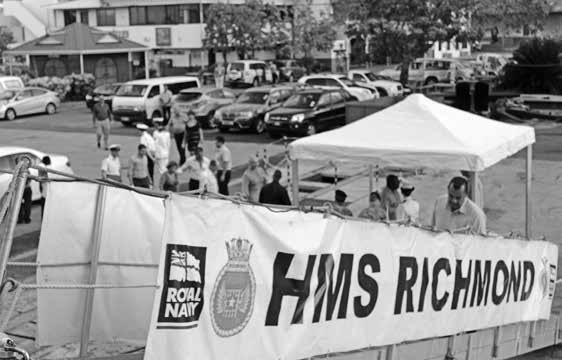
Just a few hours after the visiting British Royal Navy frigate HMS Richmond welcomed President Michel and other guests to celebrate the Queen’s birthday on Friday, one of its crewmembers, a 23 year-old Royal Navy sailor, was found dead in Victoria.


His body was discovered behind the National Library, at the ex-children’s playground, by an unknown man at around 6.45am. He then proceeded to alert the police. The circumstances of the death are as yet unclear but police spokesperson Jean Toussaint said that they are treating the death as suspicious.

The man was wearing a light blue shirt and blue jeans at the time of death. He was barefoot and, puzzlingly, his shoes and socks were placed next to him. The posture of the body almost suggested that he was asleep, with one arm on his chest and the other bent at the elbow.

The police also say that there was no “visual” evidence that foul play was involved but that the sheer unnaturalness of the discovery is what is making them treat the death as suspicious.

Matthew Harper from the British High Commission has confirmed that the 23 year-old was serving on HMS Richmond and said that his family in England had already been notified of the death.
HMS Richmond is set to leave Seychelles on Tuesday.


The strange circumstances surrounding the discovery of the body are reminiscent of the death of two security officers on board the Maersk Alabama while it was docked in Victoria last year. After a night out in town, the two men were found dead in their cabin. It was later established that they had overdosed but the people who last saw them before their death - they spent the night at the casino in town - were never identified.

Likewise, little is known about where the British sailor went before his death and who he was with. The police are expected to question other members of the crew of HMS Richmond to try and retrace the 23 year-old’s movements before his death.


In the meantime, it is hoped that the CCTV cameras in town will assist the police in their investigation. Questions however are being asked about whether the police still conduct patrols in town in the evening and the early hours of the morning and whether the patrols should not be more regular, especially on end-of-month weekends.

Source:Today in Seychelles